
Changes in the light
Notes on a capital theory of climate adaptation—and, tentatively, how to invest in a just transition for our quality of life.

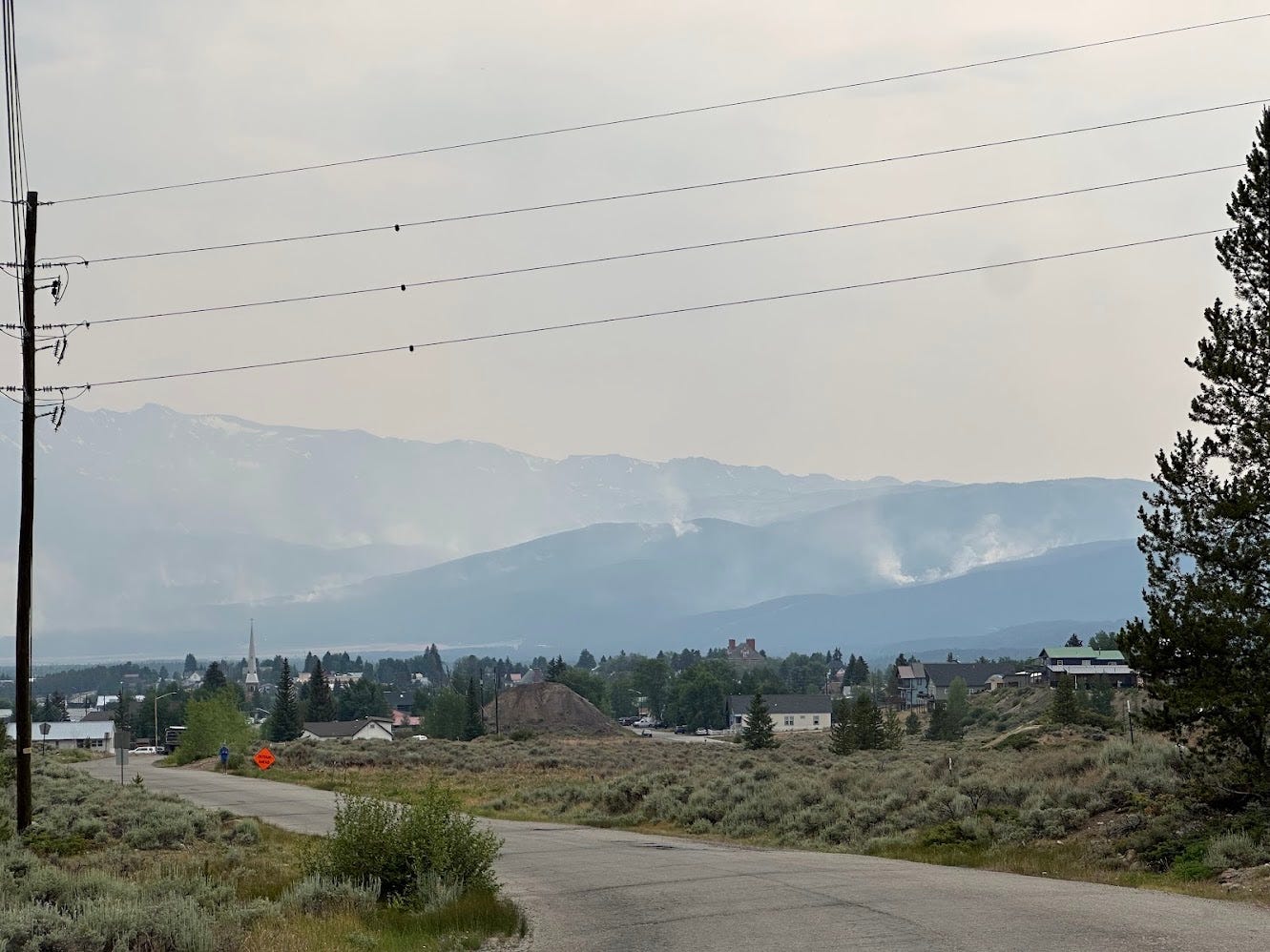
At least a third of the United States has tasted smoke in their mouth this summer—from the wildfires out West, from the wildfires in the Pacific Northwest, or from the wildfires in Canada. Wildfire smoke comes with advance warning, if you’re paying attention. The blue of the sky starts to sallow and, at sunset, the sun-lit slits between the shadows of tree branches glow brighter and sharper. Growing up in California, you learn to pick up these changes in the light. It’s a very pretty kind of premonition: There’s smoke on the way, and tomorrow will be different than today.
Sometimes these changes in the light are quite dramatic, like the day the sky turned orange above the Bay Area. I ran errands around town with a thin layer of ash covering my car. But sometimes these smoke signals are simpler, and all the more striking: In August 2021, I remember the moon above me was burning scarlet red from that summer’s wildfire smoke—and there I was, standing in a Sunnyvale parking lot with my mom, groceries in our hands. This fire moon, this man-made lunar eclipse, felt like a sign that this is just how things might be from here on out—that the world is changing irreversibly over our heads—and that’s all I could think about as we drove home to make dinner.
Wildfire, and the changing climate it represents, has been licking at the corners of my everyday life for quite some time—and, of course, everyone else’s everyday lives, too.1 The “emergency” nature of the climate crisis and its often ominous manifestations—a wildfire eclipse!—juxtaposes the exhortation that we can no longer afford a “business as usual” approach to anything with the reality that, well, my mom and I still need to buy groceries, regardless of how the planet is doing. This, to me, is the core problem of climate adaptation: What does it take to proceed with everyday life under conditions of climate change and climate disaster?
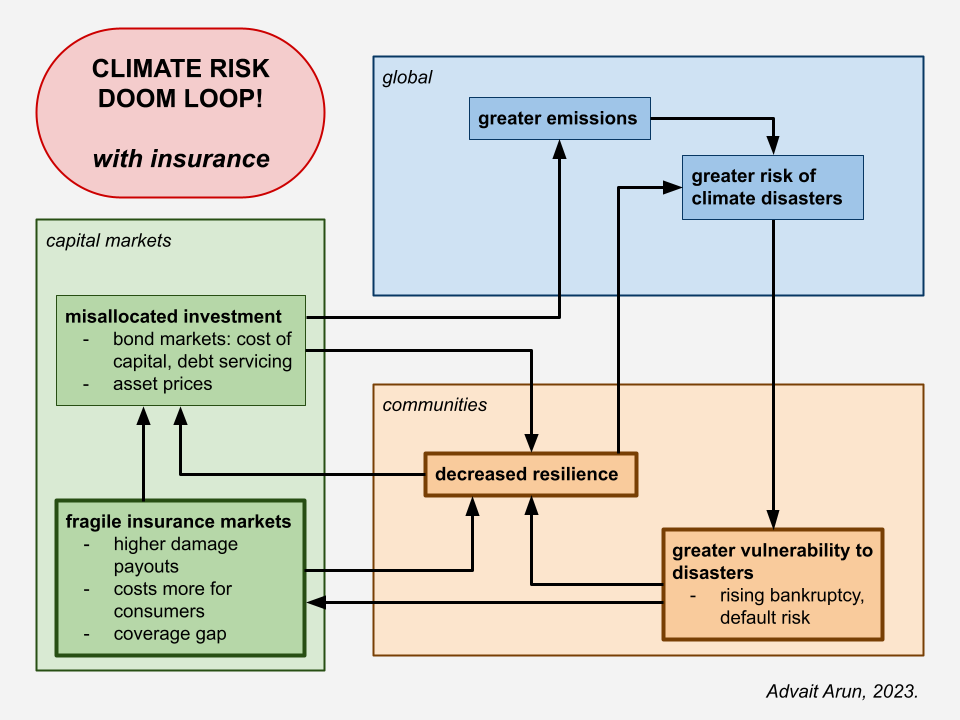
I can’t offer any easy answers to the personal and social dimensions of that question. But in terms of policy and in terms of capital, at least—my usual frames for problem-solving—the next steps seem pretty straightforward to me. Three years ago, I wrote an essay called “The Doom Loop” focusing on the limits of insurance markets, which cannot themselves address the “correlated and compounding” dangers and costs of the climate crisis:
As carbon emissions continue to accumulate, more people are put at risk of climate disaster, while the damages from those disasters intensifies. Vulnerability will drive disinvestment, which in turn exacerbates vulnerability. Communities around the world that have been made vulnerable by racialized and exploitative processes of industrialization are impacted first and worst. Tinkering with insurance markets will not solve their real issues—we must patch the gaping holes in the financial system itself.
My baseline recommendation for attenuating the climate risk doom loop was a program of massive investments in risk reduction that provide exigent liquidity to vulnerable communities. That recommendation hasn’t changed: The only way to preserve our shared quality of life is to invest into preserving that quality. There may no longer be such thing as “business as usual,” but there is still such a thing as “the good life.”
My doom loop essay does not offer a more specific accounting of the kind of assets and public investments that are necessary for policymakers to finance and maintain in order to underwrite any semblance of a good life in our increasingly erratic climate. Plodding through this summer of heat domes and hazy skies (in DC, but also in Colorado, where wildfires stymied my hiking plans) has convinced me that this accounting is necessary, if only to make clear how much of the course of our everyday lives is being rendered increasingly brittle by climate volatility—and to paint, in broad strokes, the kinds of investments that will be required to ensure our communities do not shatter under the pressure of climate shocks.
There are three broad categories of public infrastructure investments that are relevant to the climate crisis. There are the “good life” assets that we must build and maintain anyway, regardless of the climate crisis. Then there are the climate adaptation assets which must be publicly financed and developed to protect the “good life” assets. Finally, there’s the social infrastructure that will be vital for ameliorating the effects of erratic weather and responding quickly to shocks and emergencies. Each of these categories of infrastructure interacts with the crisis and with capital somewhat differently. My typology is not intended to be exhaustive—but I’ve begun to see this accounting exercise as a useful way to qualitatively systematize the interlocking and cascading effects of the climate crisis on our quality of life.
I. “Good life” infrastructure and “climate hysteresis”
The first category encompasses capital-intensive infrastructure that’s necessary for the “good life.” That includes roads, subways and railroads, clean energy, HVAC, internet and broadband, water and sewer infrastructure, and dense housing—much of which needs to be adapted to withstand our changing climate.
We build and (mostly) maintain these capital assets already, as a matter of policy, regardless of the climate crisis. Even if the state supports these assets through borrowing and taxes, as it does with roads and, to some degree, water infrastructure, these assets have revenue streams of their own: They can all help pay for themselves through rents, gasoline taxes, utility bills, and access charges. To be sure, the return profiles of these assets are not necessarily predictable. The returns on infrastructure assets generally remain dependent on persistent consumer demand and broader macroeconomic conditions over the course of years or even decades—meaning that, to secure investment, their developers will have to engineer the predictability in their return profiles.
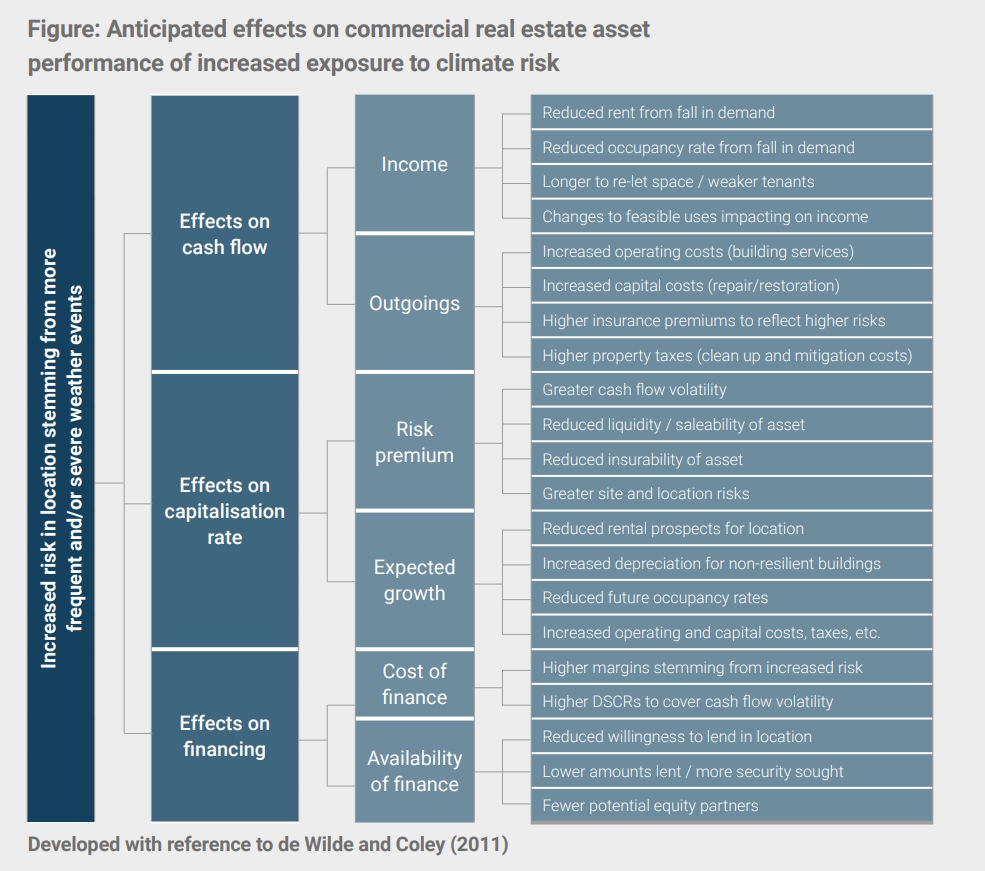
Investors, therefore, already lend to most infrastructure projects somewhat conservatively. But climate change only makes their returns—and their costs—even less predictable. Developers and project sponsors need to budget for downward surprises to revenues, whether it’s storms that cripple energy assets or heatwaves that render train tracks temporarily unusable.2 These surprises feed into rising costs, not just for insurance but for exigent operations and maintenance spending just to bring assets back online and return them to maximum capacity. These downward surprises are even more dangerous for projects that earn revenue through availability payments; insurance against asset unavailability may only grow more expensive. Project owners and developers will need to keep extra equity capital and cash on hand to spend on timely asset upkeep and to maximize asset availability.3
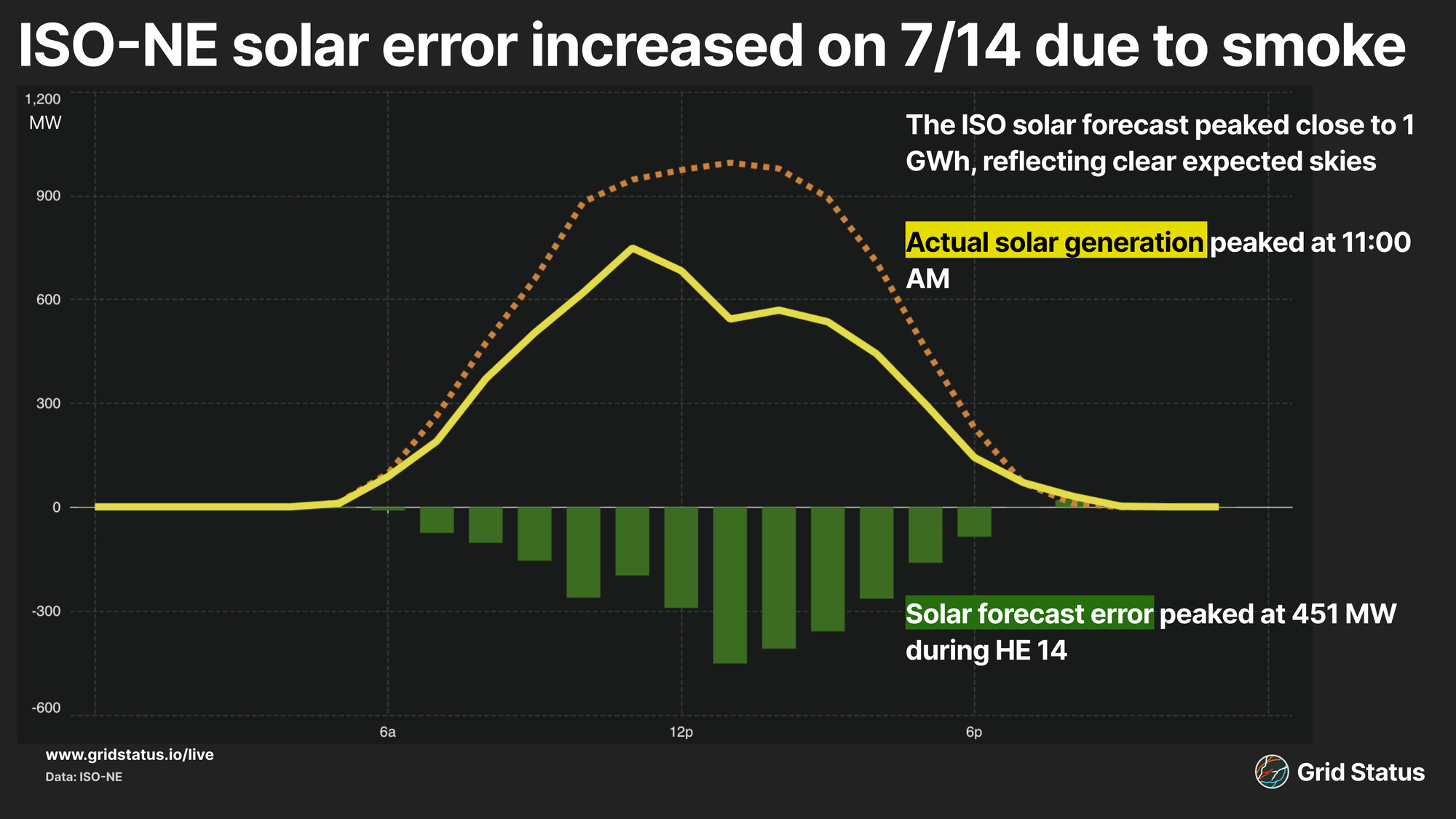
Sometimes it will not be possible to keep assets in shape: Climate volatility can reduce the capital efficiency of assets that depend on stable temperatures bands or predictable climactic conditions to operate efficiently and at maximum capacity—particularly energy resources such as hydropower, nuclear, solar, wind power assets, and even gas.4 This category would also encompass assets like railroads, as mentioned previously, and air conditioning, too. It would be appropriate to bunch these dynamics under the umbrella of “climate hysteresis”: Climate change irrevocably deranges the operating conditions and return profiles of all of these “good life” capital assets.5
On the demand side, severe and persistent climate shocks that lower consumer incomes or, worse, drive out-migration will put immense downward pressure on revenue forecasts for all of these assets, complicating debt service and access to liquidity. For some assets, the tryst of demand and supply shocks is a vicious cycle: Water infrastructure becomes less efficient and more brittle when usage undershoots expectations, driving greater O&M spending even as revenue falls.6 Lenders, in the meantime, will grow even more conservative: Debt service coverage ratios will rise while loan-to-value ratios will fall. This is a version of the doom loop in action.
Some places, most likely cities, may be blessed with some upward shocks to the utilization rates and returns of their “good life” infrastructure in the event of climate-driven in-migration. (Although, at least in the United States, I don’t think we’re there yet.) In the meantime, as we learn time and time again, there is no such thing as a true “climate haven.” Cost shocks still work the same way; New York City’s subways will keep flooding, and more often, too. The return profiles of capital assets everywhere only grow more volatile, and long-term lenders will prefer to shield themselves against downside volatility than to bet on upside surprises.
II. Climate adaptation infrastructure as a “financial seawall”
The second category encompasses capital-intensive infrastructure that’s broadly viewed as necessary for climate adaptation. That includes cooling structures, misters on buildings, sun shades across public spaces, really really big fans, public swimming pools, cooling centers, adaptive architecture, sea walls, “sponge infrastructure” and flood drainage management, and firefighting trucks and helicopters—all of which speeds along the climate adaptation process.7
The sheer necessity—and urgency—of this infrastructure speaks for itself. All of these assets ameliorate the effects of climate change on our quality of life, but some of them, such as sea walls and drainage systems and cooling centers, are shock absorbers in the event of a flood or heatwave;8 others, like firefighting equipment, are necessary for holding climate disaster at bay. And innovations like sponge infrastructure can creatively make a city more beautiful and more livable.9
None of these assets earn revenue directly—nor should they try. They exist to prop up the return profiles of “good life” capital assets by stabilizing local demand and absorbing climate-induced cost shocks. But that means these assets cannot raise finance on capital markets themselves.10 They must be folded into broader public capital plans, financed with public debt and paid for entirely through some tax-based mechanism. They will no doubt suffer from similar cost volatility issues as the capital assets in the “good life” category do—suggesting that, even if these assets are 100 percent debt-financed, their public sponsors will need to maintain the equivalent of an equity cushion to ensure that these assets work their best when they are needed most. But the “return” on these assets, at least at the local level, is realized through the persistence of tax collections that investors would treat as collateral for local public debt.11
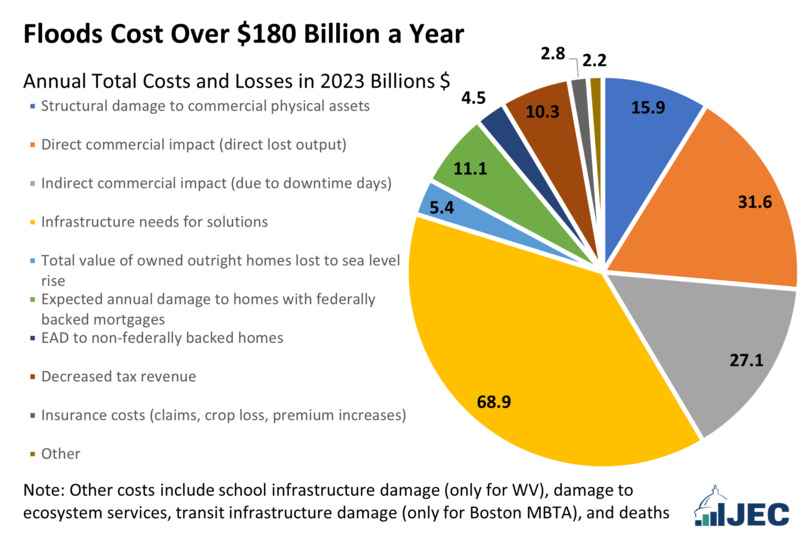
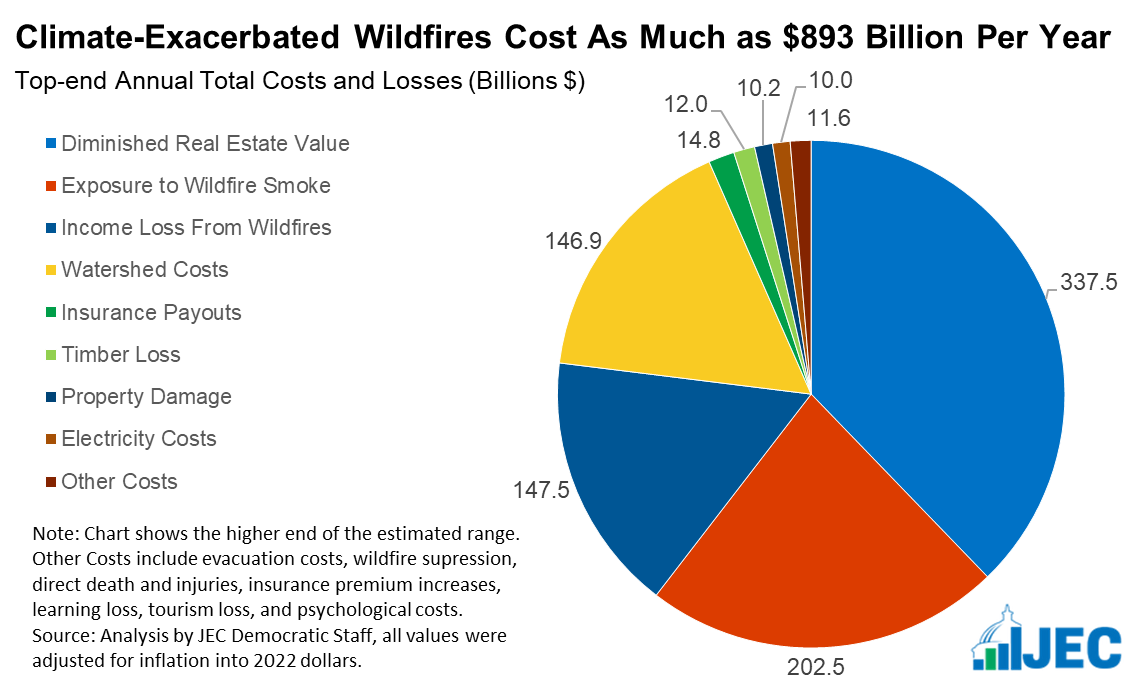
The good news—and the way we’ve always justified adaptation spending—is that spending on these assets now, however large the bill may seem, is expected to yield incredible savings later on, in the form of preserved worker productivity and a tax base that grows rather than collapses.12 To be sure, the “synthetic revenue” that these climate adaptation assets yield accrues over periods much longer than many private investors may have patience for.13 But that’s not the bad news.
The real problem with local climate adaptation investments is that each one is locked into a local growth story. Climate adaptation investments will succeed when they upgrade communities and cities such that people can stay and prosper. But what happens if cities and towns make these investments and out-migration happens anyway, or if particularly large climate shocks breach these “financial seawalls”?
We should, where possible, aggregate these investments through some kind of national climate adaptation fund, to spread the costs of protection as widely as possible (and to amortize that cost over the longest possible duration). But, to be clear, doing so only scales up the problem rather than eliminating it. A national solution might give us more leeway to finance the “charismatic megafauna” of adaptation, like seawalls—but, again, what if we’re wrong? The scale at which we finance climate adaptation is just as important as the fraught process of coordinating a managed retreat.
I suspect it will be more environmentally durable and capital-efficient to, say, pay people in flood and storm zones to move to safety than to build drainage and reclamation earthworks on sandbars like Miami Beach. Similarly, I suspect it’s smarter to buy up and mothball the mansions dotting the tinderbox hills of the American West and to invest instead in the mass construction of multifamily housing in Western cities—equipped to the gills, of course, with smoke-filtering HVAC systems. We will have to pick and choose the places that are better-positioned to receive these kinds of growth-preserving “financial seawalls” while derisking collective exposure to assets and places that aren’t.
III. Social infrastructure and a “contingency workforce”
The third category encompasses labor-intensive social infrastructure that’s also broadly necessary for climate adaptation. We’re not just talking about green spaces and greenscapes or water and mask distribution centers, but also about labor: public health workers, snowplow drivers, firefighters, maintenance workers for public infrastructure, shelter staff, and other emergency workers—all of whom constitute the flexible capacity for responding to climate shocks and natural disasters and, otherwise, help speed along climate adaptation.
The takeaway here is simple: In a climate-stressed future, there will be more service work to be done! Readers may recall the aftermath of the January snowstorms across the Eastern seaboard: While DC was stuck in a snowplow deficit, New York City moved quickly to plow and salt streets in advance—putting over 2500 sanitation workers on extended shifts (and putting snowplows on sanitation trucks) to speed up storm response. By February, the city was hiring snow shovelers off the street for almost $30 per hour.14 I imagine that managing an increasingly volatile climate will require labor-intensive responses of this speed and scale all the more often. Which calls for cash—not just to spend on surge capacity, but to keep on call some minimum volume of emergency workforce at all times. Of course, cities already do this for social services, either in-house or, for better or for worse, through delegation and grants to community institutions, and they pay for it out of taxes. (Cities also do this for police, who have a functionally unlimited overtime budget that cannot easily be hacked away at… Just imagine if we treated environmental work with similar deference.) But a world of more frequent climate shocks means that this threshold for what qualifies as a minimum viable emergency workforce will need to be set higher; after all, this workforce will be called on and will require surge capacity more often.
To be sure, the political incentives for proactive disaster budgeting are horrible. Nobody gets credit for disasters averted—especially when nobody realizes what could have happened. The political problems of campaigning on counterfactuals may bias leaders and their bureaucrats against saving for rainy days. But for leaders who care about preserving productivity, minimizing lost wages, and saving their own popularity during disasters that threaten collective quality of life, this spending cannot be avoided.
This task of labor (re)allocation will be easier to achieve in cities and suburbs blessed by population growth. I’m less sure about elsewhere—unless we can effect this reallocation nationally. Either way, creating what amounts to a “contingency workforce” for managing climate resilience, or even just setting aside funds to hire people off the street, no doubt imposes preemptive costs on a city’s budget, likely funded in advance through taxes—with the promise that payments now will attenuate future losses from climate shocks. We might as well start budgeting.
Except most public agencies can’t budget for labor the way they can for “good life” assets and climate adaptation infrastructure: Because workforce spending generally counts as operating expenditure (opex) rather than capital expenditure (capex), public agencies avoid borrowing to finance the creation and maintenance of such a workforce, preferring instead to achieve a balanced operating budget. The prohibition on the deficit financing of an operating budget carries all but the force of law in the world of public finance.
For what it’s worth, New York City has previously engaged in deficit financing—but only in what its comptroller’s office considered emergency circumstances, such as the aftermath of 9/11 and during COVID-19, when sharp shocks constrained the city’s ability to collect its projected revenues. Otherwise, the comptroller’s office considers the practice verboten:
Deficit financing, however, creates a long-term liability to manage short-term needs. This practice ends up creating more costly fixed expenses to pay for services already rendered, while adding to the City’s debt burden and taking valuable funds away from long-term capital investments.
This little paper is useful because it underscores the public finance practices that New York City has used to avoid deficit financing, including better rainy day savings collection procedures, drawing on pension contributions in exigent circumstances, and spending down the sinking funds the city considers “pre-paid” for the purpose of meeting future debt obligations. (Federal aid also helped considerably at times.) New York City’s balancing act thus involves building up sufficient buffers like these, based on the scale of losses from past shocks to economic activity and revenue collection, to draw on before needing to resort to deficit financing. There is no doubt that cities and states will employ a similar tightrope walk for managing climate shocks.15 The goal is to avoid going to market, which would “crowd out” a city’s ability to undertake more necessary capital investments.
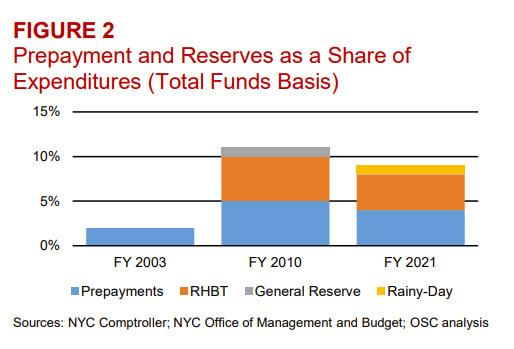
I do not traffic in “crowding out” logic here lightly. City and state governments are liquidity-constrained financial creatures, often forced by tax revolt and policymaker conservatism to maintain balanced budgets and to undertake only the most prudent of capital investments. Raising debt to pay for an operating deficit does not look to credit rating agencies and lenders like a growth-enhancing investment; plugging an operating deficit is, at best, in their eyes, a way to maintain an existing growth trajectory. Spending a greater share of a fixed pot of revenues on debt service only reduces the amount of collateral a government could plausibly post for raising debt to finance ostensibly growth-enhancing capital investments with new revenue profiles. And, however prudent it might seem to save increasing amounts for rainy days, this saving of course takes away from a city’s ability to spend directly on exigent public services and other kinds of social infrastructure that are hard to borrow for.
It’s unfortunate, then, that climate shocks will only put greater pressure on governments’ abilities to save for rainy days. There will be more rainy days, and rainier days, at that. The federal government, of course, can already choose to shoulder a considerable portion of national disaster recovery costs (mostly through FEMA) and can even help prepay for resilience through BRIC grants. But these backstops have, under Trump, been looking increasingly tenuous—not to mention blatantly politicized against Democratic-leaning states—and therefore do not ameliorate the liquidity constraint that climate change is tightening like a vise around local and state public budgets. Our capacity to raise debt to invest in “good life” assets and climate adaptation infrastructure, tenuous as it is, only looks more constrained in light of cost pressures on public operating budgets—whether those cost pressures precede a climate shock, such as the creation of an “contingency workforce,” or follow it in the exigent spending on a quick recovery.16 The challenge at hand is one of convincing voters and investors that this kind of budgeting really represents a form of proactive investment.
The “climate-cash” nexus
I admit I have painted a pretty pessimistic picture. Climate change means persistently higher costs, less predictably and sometimes more intensely, across a wider range of assets. Even if investors don’t start “pricing in” the potential impacts of climate risk on public budgets into municipal bonds, public budgets are structurally exposed to deterioration anyway. Public bond yields will start ticking up sooner or later. As a corollary to the doom loop argument, climate change first burdens public budgets with liquidity risks before it starts imposing solvency challenges on them.17
The capital structures of all three asset categories discussed above depend on infusions of additional cash to weather climate shocks, even as they can be optimized to attenuate those shocks. Call it the “climate-cash nexus”—access to liquidity will be what determines whether public entities’ abilities can respond successfully to a changing climate and greater disaster vulnerability, full stop.
Access to federal liquidity does wonders for local governments’ financial stability. Programs like FEMA’s BRIC grants or a climate/disaster-focused version of the Fed’s 2020 Municipal Liquidity Facility, which backstopped municipal bond markets during the pandemic, will be absolutely essential for supporting local and state investments in all three asset categories. What adaptation no doubt requires is a program of public credit creation to tide over the coming climate-induced liquidity shocks facing consumers, asset owners, and governments.
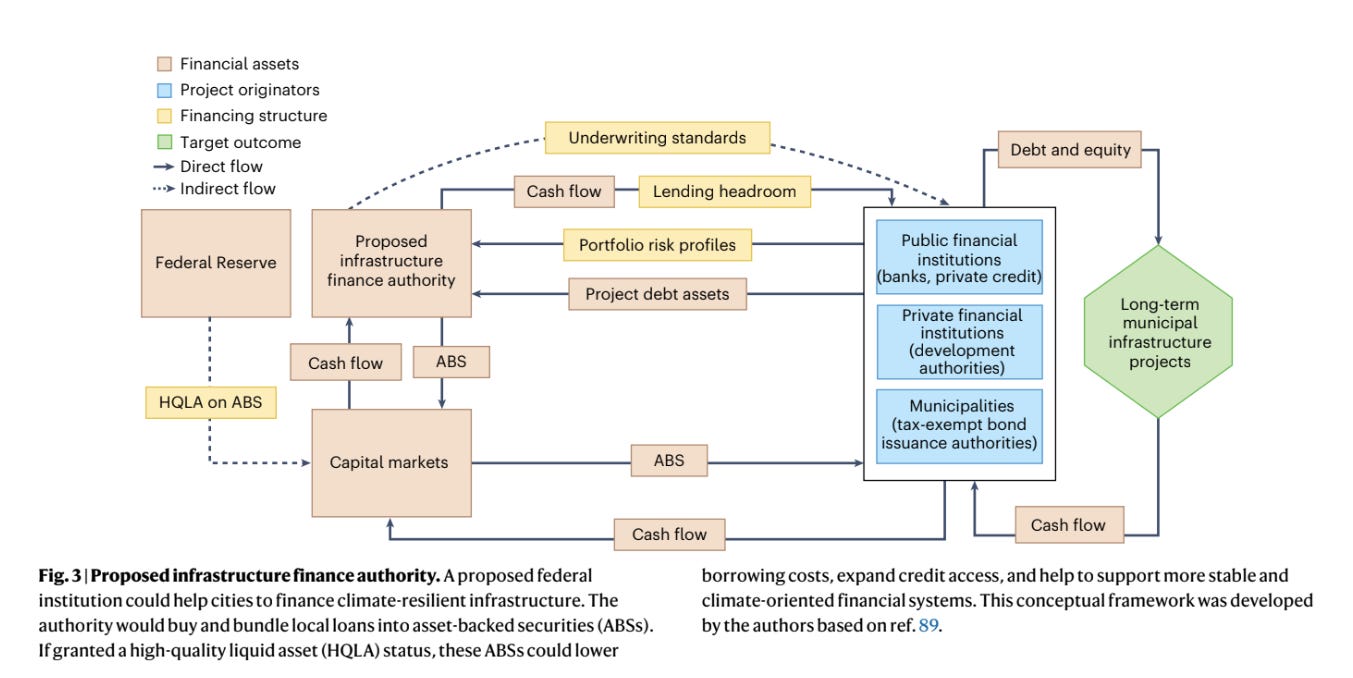
But let’s assume that these backstops are not easily available. What else can liquidity-constrained governments, public agencies, and private developers do to get the cash they need into necessary projects?
As I see it, each category of assets interacts with the climate-cash nexus in slightly different ways. Developers of “good life” assets need more low-cost equity, especially if lenders cap their loan-to-value ratio limits to shield themselves from concentration risks. Perhaps that equity comes from federal or state grants. It could also flow through the tax code—most likely through loss writeoffs and accelerated depreciation for properties constructed in generally less vulnerable areas and with best-in-class green building standards. (There is no reason to reward building in danger zones.) I don’t claim that regulating these tax benefits will be easy, especially with private asset owners—but they are surefire ways to build equity buffers in a property owner’s capital stack that can be used for reinvestment. Making returns more predictable will help suppress speculation in critical and growing real estate markets, in particular.
But the challenges of climate risk are also a clear case for greater public ownership and development of “good life” assets. Public owners can take longer-duration and higher-risk investments in all manner of assets—and as climate change only raises investment risks’ and scares investors into shorter-term investments (as per their liquidity preference), public owners and managers should play an increasing role in the system. The public sector can ensure that “good life” assets can exhibit a correlated capital structure: As climate shocks depress asset values, liabilities should also fall in tandem to preserve the asset’s net position. But all of the promises of public ownership depend on the public sector’s access to adequate liquidity and the ability to write off losses in a manner comparable to their private counterparts.
The public sector will inevitably develop, finance, and manage capital-intensive climate adaptation assets—even if they pay private engineers and contractors for construction, management, and operations. These public “adaptation asset managers” will also need the equivalent of equity cushions. Maybe their cash balance sheet comes straight from greater progressive taxation—which seems required in any case. But the federal government, or state governments, could also directly prop up these assets with hybrid capital instruments, such as “consol” bonds, which pay back interest in perpetuity. These instruments are useful precisely in cases when external shocks might render principal repayment timelines uncertain.18 Policymakers could also create some kind of forced savings program for insurance companies and property owners by requiring them to remit a portion of their insurance premia into funds for investing in or recapitalizing critical adaptation assets—the success of which will attenuate future insurance cost spikes and preserve a region’s broader tax base.
To be sure, programs like these cannot succeed everywhere; some assets will have to be written off in the event of out-migration and tax base collapse. But these investments need to be made proactively, no matter where they are. Our only shot at doing so at scale, absent federal liquidity, is to undo the conservative tax revolts that have decimated public borrowing capacity and forced the public sector into greater discipline by private investors.
Labor-intensive social infrastructure is the thorniest of the three to capitalize. But a frame shift helps clarify the stakes: What public agencies are really spending on when they invest in a “contingency workforce” is a call option of sorts on their city or their region’s quality of life, tax base, and expected growth trajectory. The purchase price of the call option is the cost of staffing climate resilience offices and emergency response teams with the minimum capacity they need to work proactively, plus the cost of budgeting for hiring surge capacity. The cost of carry is, roughly, the opportunity cost of having spent on this reserve of labor that could otherwise be allocated elsewhere. And exercising the call option during a climate shock is tantamount to limiting, as much as possible, the losses of that shock: disruptions in people’s daily lives paid for in worse health outcomes, lower productivity, and higher costs for goods and services; destruction in asset value that compounds over time if left unaddressed; and future tax receipts.
The administrative task of purchasing and reserving this contingency workforce is also an opportunity for improving their organization, management, and “well-oiled”-ness. One silver lining of the climate crisis is that emergency workers will inevitably “learn by doing.” Another is that such a contingency workforce will gain the time and capacity to liase with community leaders, vulnerable residents, and mutual aid groups, channeling their work and their worries in an organized direction.19 Spending on a contingency workforce is also a demand signal that such a workforce will be required from here on out—a signal we can reshape our education and training institutions to accommodate.
Anyway, failing to invest in asset maintenance and prompt disaster response would end up reducing the returns on “good life” investments as people stop wanting to move into new apartments or use public transit in perceptibly vulnerable places. “Good life” investments suffer and, longer-term, the overall tax base will, too. This is another manifestation of the doom loop in action—and everywhere is vulnerable.
All of which is to say that policymakers must make investments in these opex call options viable for local and state governments. Putting the costs on the federal balance sheet is best: This way, areas with less intense climate shocks in a given year cross-subsidize those with more intense shocks. Cross-subsidization has its limits, as discussed—but federal taxation and spending policy has historically redistributed tax revenue and the fruits of economic growth to poorer states anyway. Absent federalization, maybe the solution relies on cities and states persuading lenders and credit rating agencies and, of course, raising taxes and special assessments to build rainy day funds and proactive risk management institutions. But this, too, requires undoing the tax revolt.
It’s not that nobody has done this kind of thinking about adaptation before. But, while adaptation finance is a rich research area, I get the impression that the existing literature focuses almost too much on (1) quantifying the concepts of “physical risk” and “transition risk” and on (2) trying to understand how climate risk gets “priced” into asset values. It might be more worthwhile to take an asset-first approach to climate risk: By taking a step back from the quantitative modeling to focus on the kinds of assets we know we need to build and maintain, and then taking a step back even further to think conceptually and qualitatively about the basic balance sheet dynamics at play, about the unique ways climate change stresses those balance sheets, we can make heads and tails of what an appropriate policy response requires.
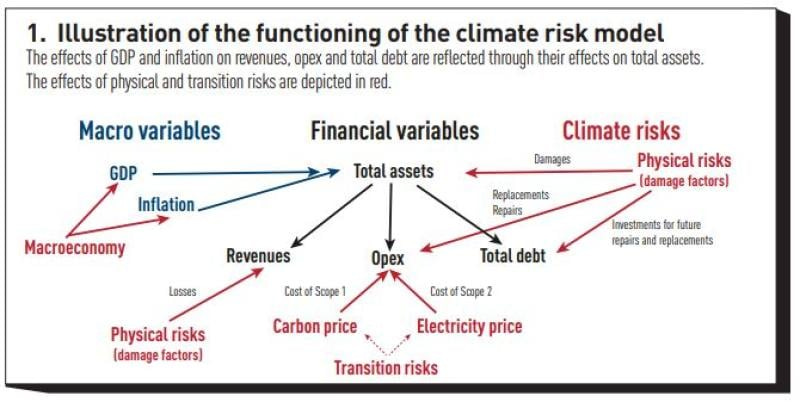
The thing to avoid is climate hysteresis, where a deterioration in the quality or returns of keystone assets in a city or a community in the aftermath of a climate shock leads to the deterioration of the overall tax base and the regional growth trajectory—and to a concomitant deterioration in that place’s quality of life.
Really, this is just another version of the just transition problem. Only this time, the transition is not anchored around polluting industrial assets; it’s anchored instead around core public services that help communities, economies, and markets function smoothly. A just transition for our quality of life requires a politics that tolerates greater public investment—and that provides avenues for choosing where those investments are most urgently needed.
I know less about how climate change is reshaping our agriculture and food systems, but the volatility dynamics and cost pressures look similar to those facing “good life” infrastructure. Investments in agroecology and agriculture technology to preserve both yields and land quality under conditions of climate stress will require considerable R&D—to say nothing of the likely need to drastically reduce meat consumption and/or shift it into synthetic and lab-grown alternatives.20
Another category of infrastructure I didn’t get into is the set of capital-light and labor-light information technology investments that adaptation will occasion: for example, the kinds of apps that people can use to collect and disseminate climate information, mark themselves safe during disasters, or call on city officials to check in on neighbors they haven’t heard from.21 These community safety service apps will only grow more important to maintain as climate shocks put pressure on the management capacities of public officials and their contingency workforces. But no matter how we categorize these information technology investments, they will need to be publicly financed and managed. This feels non-negotiable: The alternative is reliance on privatized, securitized, and neurotic neighborhood “safety” services in the vein of Citizen, Flock, and Protector.
My perspective here is biased toward cities and state governments, the capabilities of which I understand better—and which, for the most part, have resources and tax bases that smaller towns and rural counties might not. The kind of adaptation spending structures I am suggesting policymakers create will be harder to maintain in the parts of the United States with fewer people, smaller tax rolls, and facing persistent outmigration pressures even absent climate change. But those communities will demand protection, too. Perhaps those demands will create a political purpose for instituting a national adaptation financing program, which could continue the great American tradition of subsidizing the rural heartland with the returns of urban America.
There’s a political question about the American constitutional settlement embedded in this argument, too. It has always been fundamentally unfair that our political system allows land to exercise outsize sway over our politics; the median American gets less than one vote per person. This bias, enshrined in law, drives the circular conclusion among much of the media, policymakers, and politicians that urban and suburban Americans (the majority of the country!) are less “real” or authentic—and are therefore less worth building a politics around—than the imagined salt-of-the-earth rural American.
Any democratic adaptation program worth its salt—built to distribute investment such that it helps the most people maintain a decent standard of living under conditions of climate change—will be critically endangered by this minoritarian status quo: There will be reactionary Republican rabble-rousers who will inevitably make a stink about how coastal urban elites are ignoring the concerns of the rural American and diverting resources to their cities and their public services—despite the fact that they are likely the very same people who deny the fact of climate change and, perhaps worse, in their position as public figures, deny public investment to communities that need it.22 There will also be small-town and suburban moderates who, in their overwhelming preference for propping up their property values and protecting themselves from climate-induced wealth destruction, might be more inclined to support ad hoc and uncoordinated national-level investments in the “charismatic megafauna” of adaptation infrastructure so long as they don’t need to move. This politically empowered homeowner class might consequently downgrade the importance and urgency of adaptation investments in populous cities and for urban renters, in particular. The Achilles heel of climate adaptation politics is that we listen to groups like these and let them influence resource distribution—or the coordination of a managed retreat.
Also, let’s not forget: Climate change, however slowly and quietly it burns, is entirely man-made. When I see wildfire smoke shrouding the Rockies and see dust floating off the pavement in DC, I do not just see a new, unfortunate normal to adapt to—I see the predictable impact of our wanton combustion of fossil fuels. We cannot avoid paying for the consequences of a perhaps irreversibly changed climate. But that shouldn’t preclude pushing our worst polluters, our largest emitters, and those who profit off of their intransigence to help foot the bill.
Maybe I am projecting onto the challenge of adaptation a melodrama it does not yet possess. For most people, I think adapting to climate change will feel pretty quotidian. Bad days are not in and of themselves climate emergencies. Where this summer is concerned, our most urgent task has been to learn how to deal with some more smoke and the increased risk of heat stroke. Even as each year shatters the records of the last, our first responsibility will always be to take care of our own, to get the groceries and to make dinner at night. I think we can judge the success of an adaptation program by how possible this is, for everyone, no matter what the color of the sky is. In the face of planetary shifts that will destabilize our sense of “everyday life,” we must create and then invest in a new sense of what hearth and home can be that accommodates all the instability brought on by an uncertain future. How my mom and I get groceries will have to change—hopefully, in the future, we can avoid driving through suburban sprawl to get them—and I look forward to the possibility. The future will be different, but it need not be bad.
Unlike the challenge of climate mitigation, which ends with carbon dioxide drawdown, climate adaptation has no end date. Even with ample investment and flush coffers, it requires complex decision-making and flexible planning—from everyone. The light will always be changing. But, so forewarned, we can always choose to change with it.
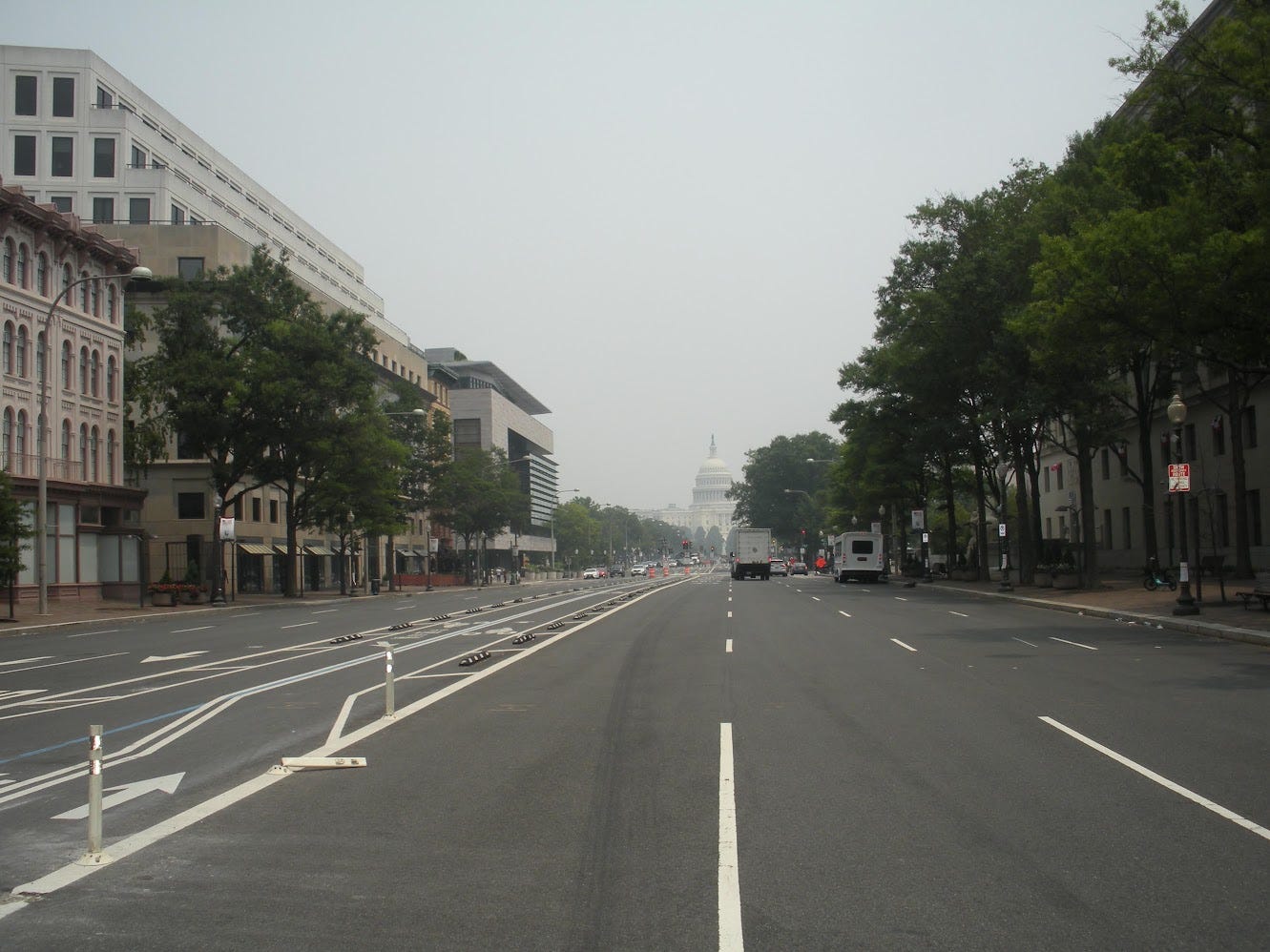
California gets a lot of smoke—but the rest of the West is rapidly becoming a tinderbox, too. This is a great piece from Grist about how wildfires are reshaping kids’ summers.
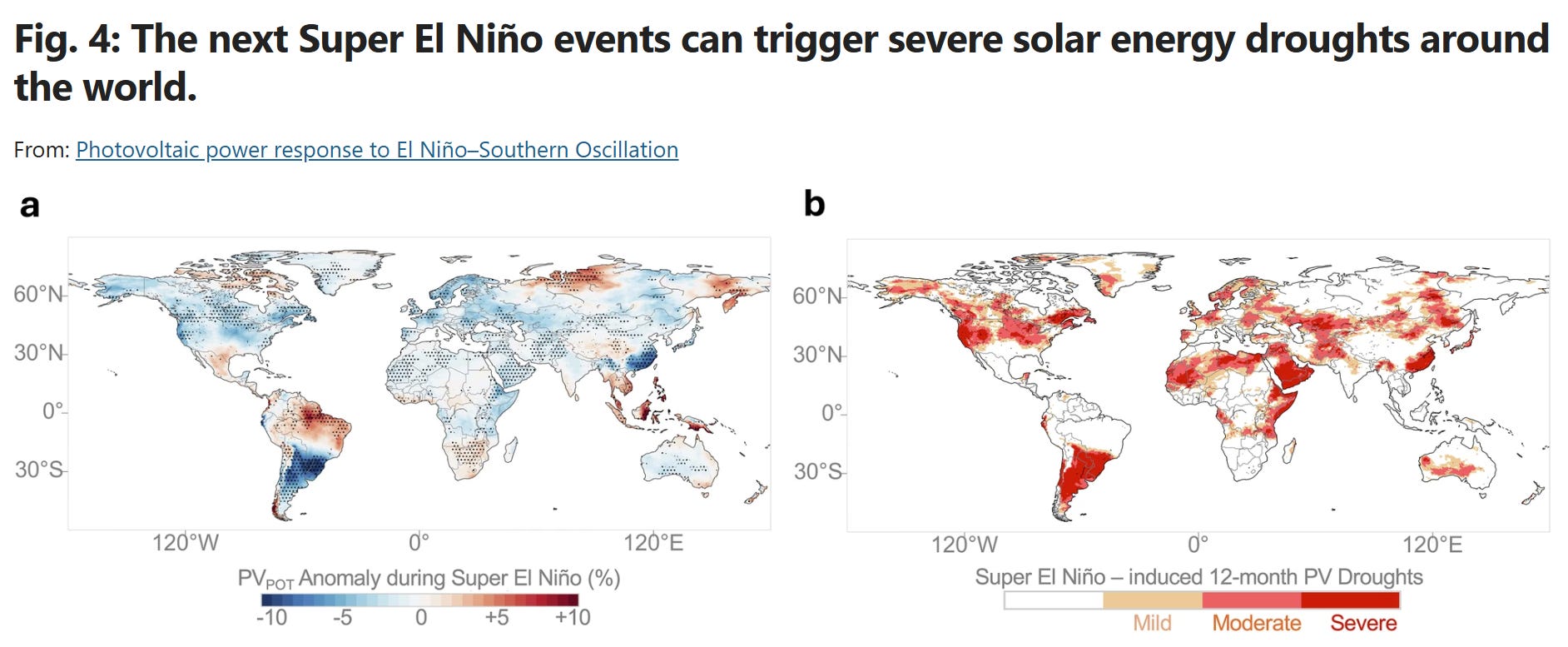
The chart below, from Feron et al. (2026), demonstrates how a Super El Nino storm system could drastically reduce the output of solar energy worldwide—and, by implication, increase carbon emissions.
A recent Utility Dive piece about El Nino cites BNEF’s Haley Lai: “Lai added that storm-related costs, often recovered over time through rates or surcharges, can result in customers paying for restoration long after an event. Public funding or regulatory action may offset some costs, but typically not fully, and underinvestment can result in repeated outages and more expensive recovery efforts.”
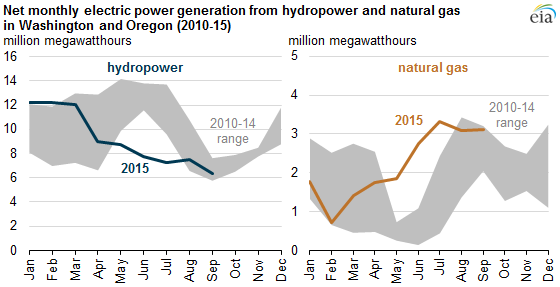
The EIA recorded the impact of the last El Nino cycle, in 2015, on hydropower in the U.S. Pacific Northwest, and noted how gas surged to accommodate the region’s drought conditions. This is just one of the many charts I could share about this issue.
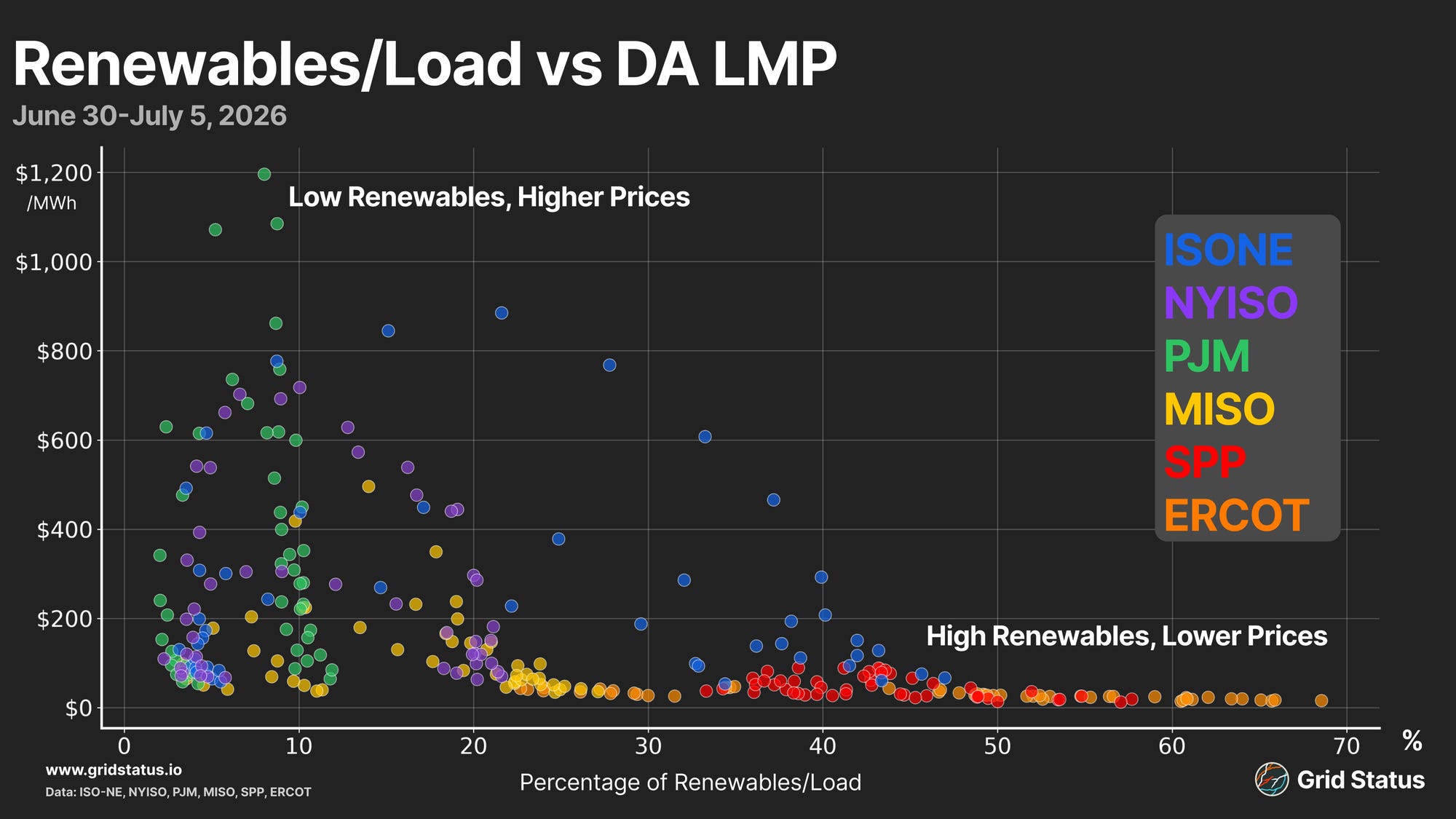
Disclaimer that I don’t consider natural gas power plants to be a “good life” asset. We should get rid of those! On the bright side, renewable power pulled its weight in the recent heatwave:
I learned this anecdotally from a friend who works on water infrastructure financing and municipal bonds. It’s an inverted capital structure!
HVAC installations count, too—but I include heating and cooling in the “good life” category because we’d want it anyway. Nonetheless, we should also still treat HVAC as necessary adaptation infrastructure, and support tenants’ rights to cooling while we’re at it.
As Kim Cobb, a climate scientist at Brown University, told Politico: “Even a modest increase in baseline temperature causes an exponential increase in heat extremes. You find yourself crossing these heat extremes much more frequently.”
I really like this interview with Eric Klinenberg in New York Policy Forum:
One of the key features of the Sponge City approach is thinking of climate infrastructure as social infrastructure—the physical places that shape our capacity to interact. If you’re investing in infrastructure for climate adaptation, you should always include a well-designed social infrastructure feature, because otherwise you run the risk of having a dumb wall that never gets used for anything other than flood protection, say once a year. Sponge City approaches are commonly developed through things like parks, play spaces, sports fields, and gardens. … I believe the future of climate adaptation has to be getting multiple benefits out of single projects in this way—using playgrounds as invisible flood management systems. Hoboken’s ResilienCity Park is one example of this approach: a very lush, green space, with a soccer field, an amazing playground, and a sunken basketball court, like the ones that NYCHA has also been building to store water, all sitting on top of a massive water basin. And it’s incredibly helpful in preventing rain-related catastrophe in that city.
Proposals to “mobilize private finance” for adaptation are dead ends for this reason.
I am assuming these assets are local, not national. If these assets were national, their “returns” would be realized through economic growth more broadly, since tax revenues are not collateral for Treasury bond-financed public spending.
The Senate Joint Economic Committee Democrats, in 2023, tried to assess the deleterious impacts of extreme heat on workers and to assets:
the loss of productivity caused by heat is emerging as one of the biggest economic costs of climate change. A recent study on the effect of temperature on productivity found that, while extreme heat harms agriculture, the impact on productivity in manufacturing and other sectors is larger – in part because they are more labor-intensive. Heat increases absenteeism and reduces work hours and these effects are expected to grow as the world warms. In 2021, data showed that more than 2.5 billion hours of labor in the U.S. agriculture, construction, manufacturing, and service sectors were lost to heat exposure. Another report found that, in 2020, loss of productivity from heat exposure cost the economy $100 billion with annual costs expected to grow to $500 billion by 2050. A recent study showed that as temperatures reach 90 degrees Fahrenheit productivity drops by about 25%, and it falls by 70% as temperatures reach 100 degrees Fahrenheit.
Not all investors: In some states, insurance companies are paying homeowners to install storm-fortified in order to avoid spending on massive disaster payouts to those homeowners in the near-term. The “synthetic revenue” that comes from cost savings is readily apparent.
And that was just the base pay. As per PIX11: “The pay was previously set to start at $19.14 an hour, increasing to $28.71 an hour after the first 40 hours worked in a week. But due to blizzard conditions, New York City is offering $30 an hour and $45 an hour after 40 hours.”
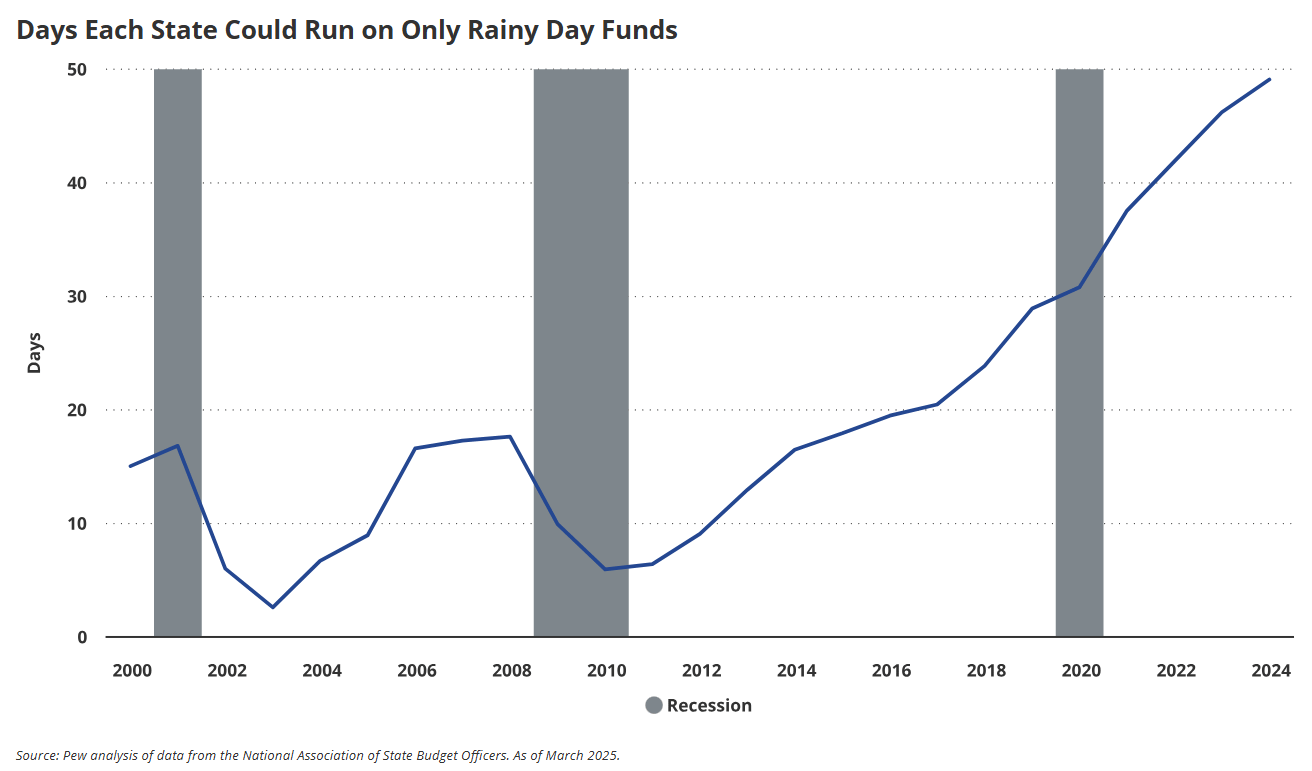
While the National Association of State Budget Officers presents data showing that rainy day fund sizes have been rising over time, this picture does not, of course, account for a sharp shock to public opex spending:
This argument is analogous to problems with New York City public housing: NYCHA’s ability to make longer-term capital investments is constrained by the fact that its aging housing stock demands increasing amounts of opex.
My friend and colleague Aayushi Mishra wrote a brilliant paper for Nature Cities assessing the threats that abrupt climate risk-related municipal bond repricing poses to communities, lending heft the “doom loop” concept.
As I have previously written:
Consol bonds were so popular in the 18th century because, as the Congressional Research Service writes, “governments with major expenses due to war or other causes could not be certain when they could pay off or roll over debts. Perpetual debt instruments gave finance ministers more flexibility to choose when debt would be retired, rather than having to repay principal at a fixed maturity rate.”
The climate crisis will no doubt lead to the expansion of mutual aid and local solidarity organizations, especially among neighbors motivated to care about each other. But mutual aid emergency response is not solely the province of the left. Zoya Teirstein has an incredible piece from 2023 about how right-wing paramilitary and emergency response groups have upstaged FEMA in disaster relief work: “By arriving to crisis zones before federal agencies do, the Oath Keepers take advantage of bureaucratic weaknesses, holding a hand out to people in desperate circumstances.” In this respect, the left has serious ground to make up—but more effective state-coordinated channels for emergency response are also clearly required to displace dependence on these smaller collectives.
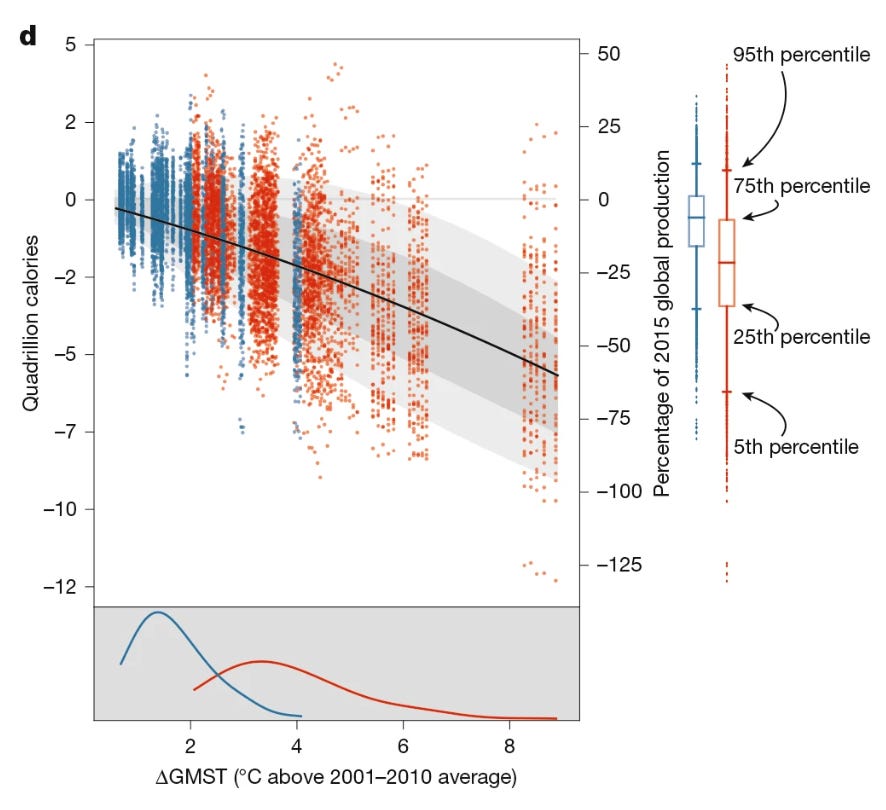
The chart below, from Hultgren et al. (2025), tries to quantify the loss in global grain yields across two different RCP emissions/warming scenarios.
Let’s put the “app” in adaptation? Sorry.
These are people who would refuse to expand OSHA heat protections or support a right to cooling for tenants.
At this point, solar radiation management is inevitable. It’s just a question of how much pain will be tolerated before we make the decision.