
Reject identification, embrace the hyperobject
Reviewing Jonathan Miles' Eradication: A Fable.

Climate change is sometimes described as a “hyperobject”―a problem too immense and too borderless for any one person to comprehend. The term sounds foreboding in its abstraction, weighed down by everything it encapsulates yet weightless in its lack of referents. You cannot understand a hyperobject; you can only gape.
To be sure, the problems of climate change and ecological destruction are very real, and they manifest in concrete, evocative phenomena: Weather patterns grow more erratic, the pollen this year seems worse than the last, plastic clogs the beaches, and the sixth mass extinction continues apace.1 The end of the world as we know it is a real problem, and, with some effort, we can trace its intertwined causes and effects to the rapacious and deranged political systems governing our shared (and nonhuman) commons.
But what the term “hyperobject” gets right, for all its detachment, is the painful admission that individual efforts to address one problem may do nothing to solve the next one. This framing very openly induces despair in all who use it. What’s the point of sanding down one corner of a hyperobject if a million others remain? First despair, then cynicism: What good is incremental harm reduction if the social and political systems we participate in keep producing new harms?
Insofar as cynicism is a political liability; it seems smart to avoid “hyperobject” framing in polite professional conversation.2 But I think it represents a tantalizing literary challenge. How can fiction―built as it is on the exploration of individual, not collective, subjectivity―look the natural world in the eye and accept the challenge of trying to comprehend that hyperobjectivity?
Jonathan Miles’ Eradication: A Fable seizes this challenge by the horns. Adi, a schoolteacher and musician reeling from the death of his young son and subsequent divorce, takes a job on Santa Flora, a faraway Pacific island—to get away from it all, but also to feel like he’s contributing to something meaningful. Adi’s world may have ended, so he throws himself into the task of saving the world of Santa Flora. His job is to kill all the invasive goats3 that are apparently making the island uninhabitable for its native flora and fauna. He has five weeks and one bolt-action rifle.
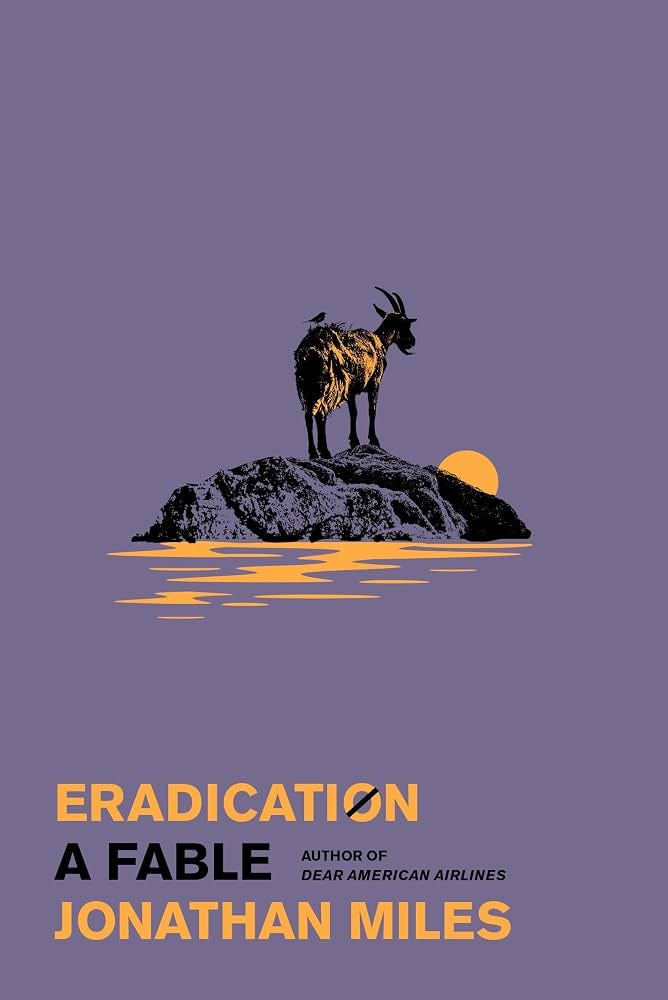
This is a book about killing goats. The premise is absurdly specific, but the beats of this story are familiar metonyms in the controversies surrounding conservation work: Adi’s employers at an environmental nonprofit misunderstand Santa Flora’s biome and overestimate the impact of their grand idea to save it; Adi meets two fishermen illegally hunting for sharks who chide him for assuming the moral high ground, despite the fact they’re both paid to kill animals; and, of course, Adi, the naive do-gooder, is really bad at shooting goats.
This is also a book about making sense of grief, about making meaning out of the world after tragedy unmoors you from your sense of the familiar. Adi’s scrambles around Santa Flora’s blasted, goat-chewed bluffs are also scrambles across his own treacherous mind. He can’t stop remembering and reevaluating the circumstances of his son’s death, which may or may not have been an accident,4 as well as the dissolution of his other relationships in the fallout. He’s crashing out, but he’s trying his best to keep it together and build a new sense of self. He saves a small bird with its wing broken by a goat stampede (occasioned by his own stray gunshot) and realizes the bird belongs to a species thought to be extinct. He befriends a rat. He befriends the female goats. He makes a flute out of a goat horn and plays songs for all his new animal friends around his firepit. For one starry night, he feels something close to peace.
But, here, Adi commits the most basic of category errors: He projects human meaning onto his relationships with these animals, and with the island. Inevitably, this attempt at meaning-making is frustrated—by the animals, mostly—in increasingly sad and brutal ways. But that’s a very human way of looking at things. One could just as easily say: Nature doesn’t give a damn. To freight Santa Flora with any meaning or significance is to misunderstand it, at one’s peril. Adi begins to reject his own desire to make sense of the island. Also, lest we forget, he has a rifle:
“Whichever goat he chose to shoot first was meaningless: every one of them was an identical ecological toxin, cancer cells that bleated. There was no moral calculus to the selection, then, no principle that could slot one goat in front of another in the rifle queue―only sentiment. Nothing he was feeling could possibly matter.”
Eradication embraces the hyperobjectivity of the natural world only to suggest that trying to comprehend it with merely human faculties is a futile endeavor―one that, in Adi’s case, leaves him feeling foolish, cynical, and paranoid.
Although, in Adi’s defense, he had already arrived on the island feeling that way. This whole time, Adi has been in the throes of a second sort of hyperobject: The death of his son. His attempts to impose meaning or narrative coherence to the end of his world, beyond the fact that it happened, are inevitably inadequate. Adi cannot see past his tragedy, because everything he looks at is part of that tragedy:
“If no order was articulable, then randomness was all there could be, fate as a dice roll. But what did that make Adi himself, crouched now behind his rifle―a mere instrument of dumb chance? Did it make him the hand or the dice? Could there truly be no reason―not one―that one goat would die this morning while another would watch the sun set behind the ocean? Was there really no reason―not one―that his son Jairo was dead while everyone else’s sons were still alive?”
If Santa Flora and Adi are synecdoches for nature and man, respectively―hence the “fable” in the book’s subtitle―then man’s inability to make sense of his individual place in nature renders him incapable of making sense of the natural world as a whole. In other words, Eradication accepts the challenge of comprehending the hyperobject, only to accept defeat.
In this loss, I think Eradication succeeds admirably as climate fiction. It succeeds because it’s also cognitive fiction: Eradication is about the irresistible urge to make sense of events through metaphor and narrative, which enable people to get their bearings on the world—and how feelings of grief and duty can warp those bearings, even disable them.
I’m reminded most strongly of Stanislaw Lem’s Solaris, perhaps the pinnacle of cognitive fiction, where the protagonist, Kris Kelvin, a psychologist, is unable to make sense of the eponymous alien planet he is tasked with studying from orbit. The planet is itself an organism, a gaseous compound that exhibits a fascinating kind of life but defies human categorization. No image or description does it justice―or explains anything fundamentally novel about it. The latest experiment to study the planet-organism goes wrong and rebounds on Kelvin’s research team, who begin to be visited by corporeal apparitions of people they have lost. Kelvin sinks deeper into the task of resurfacing suppressed memories, reinterpreting his own past, and trying to judge if he can build a future with his visitor, an old lover. He tries to engineer an escape with her, to take her back to Earth; he fails. The incomprehensibility of Solaris is mirrored by Kelvin’s struggle to comprehend his own life. Needless to say: None of the researchers ever arrives at any greater understanding of the planet they were sent to study.
Eradication similarly refuses to embrace its own images. They confer no greater comprehension, of anything. “A rat couldn’t be anything but a rat, after all, as perhaps a man couldn’t be anything but a man. Maybe existence yielded to its own semblance of gravity.” It is ultimately better, Adi concludes, to reject any feelings of identification with a world that won’t return the favor.
Except the world that Adi rejects is humanity, not nature. Eradication ends with (slight spoiler?) an irreparable and incontrovertible act of violence that, to Adi, could signify his successfully becoming one with nature―turning the natural world’s infinite, incomprehensible, and meaningless brutality back onto humans. The irony is, of course, that he merely cements his own humanity in arrogating a bloody teleology to the world around him.
With such an incomprehensible subject as nature, maybe this failure to transcend the human is inevitable. Then again, we already demonstrate an incredible incapacity to recognize other people, and even to comprehend ourselves. This is the core of the tragic form: to claw at recognition, fail, and, in the process, surface the impossible complexities of human subjectivity in the process. But the tragic form always leaves the door open for its alternative—the chance that it was possible, after all, to recognize and be recognized in return. For a character to fail at this demonstrates that they’ve tried. To continue to hold the climate change hyperobject up to the light, however futile our attempts to make sense of its structures or to solve the problems it poses might be, is to admit that it matters.
Good climate fiction like Eradication displaces the general problems of literary subjectivity onto distinctly nonhuman objects. Santa Flora will outlast Adi; nature will outlast man. The hyperobject isn’t thinking about us at all. But it’s there anyway, governing the conditions of our continued existence. So we might as well at least think about it.
As I write this, DC is blanketed in 250-AQI wildfire haze.
It may be easier and more evocative to describe the problem of tackling climate change as something like having blind men describe an elephant. At least this mental image usefully clarifies the stakes: It allows for argument, for error, and for the resolution of competing perspectives, even in the absence of total comprehension. Treating the climate crisis as something we can only understand through productive disagreement legitimizes collective action and sanctions second-best solutions. This image is undoubtedly more useful as an idea for climate politics.
It’s implied that his son’s death probably was an accident—but there’s some latent suspicion of two teenage neighbors.