
A really bad Western
American reactionary futurism on display in Detroit.

On Sunday, the New York Times reported, correctly, that last week’s Reindustrialize summit in Detroit spliced together the nightmares of Paul Kennedy and Alex Karp:
Speaker after speaker emphasized that military power flows from industrial power, which they said had been eroded by the offshoring of factories and an overemphasis on software, apps and financial products.
This unabashedly conservative summit was quite inclined to saber-rattling: Members of the Trump administration and high-profile Republicans delivered keynote speeches, and most of the other speakers and panelists, many of whom are technology entrepreneurs hunting for some cushy defense contracts, played up the threat of Chinese market and military dominance. Even Jake Sullivan, Biden’s national security advisor, spoke on a panel, lending a flair of bipartisan legitimacy to the summit.1
None of this is good news—but what caught my eye was something I don’t think anyone has reported on: the images.
Oh, god, the images.
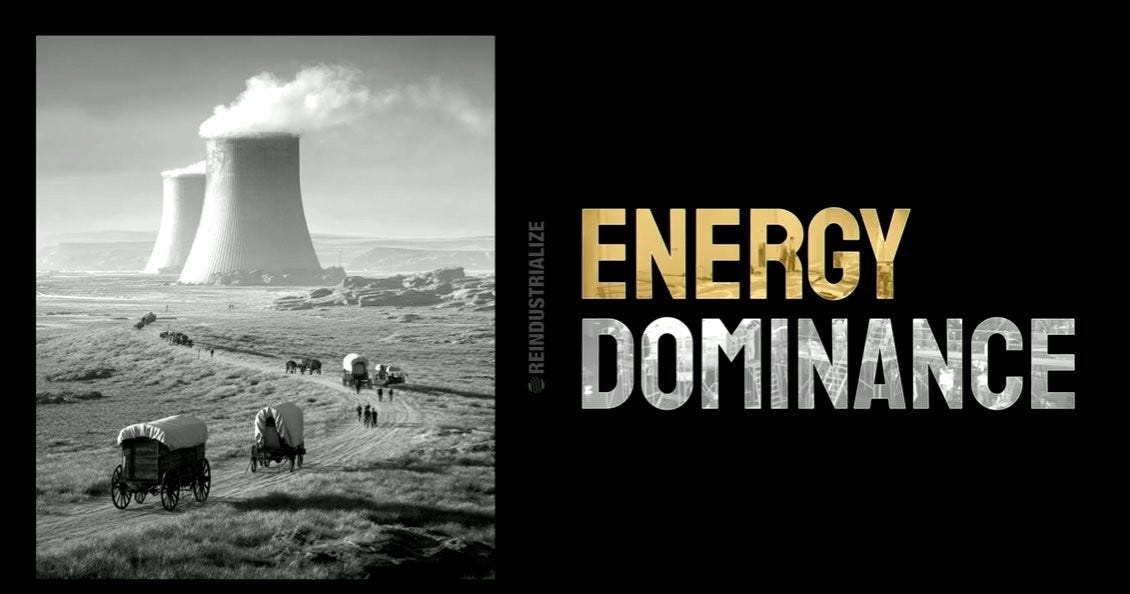
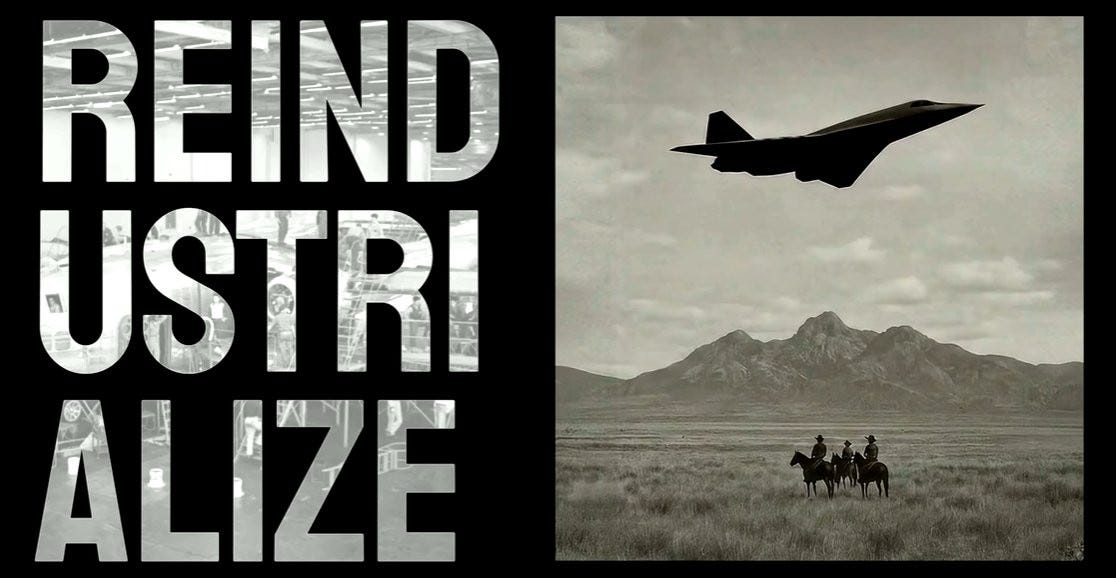
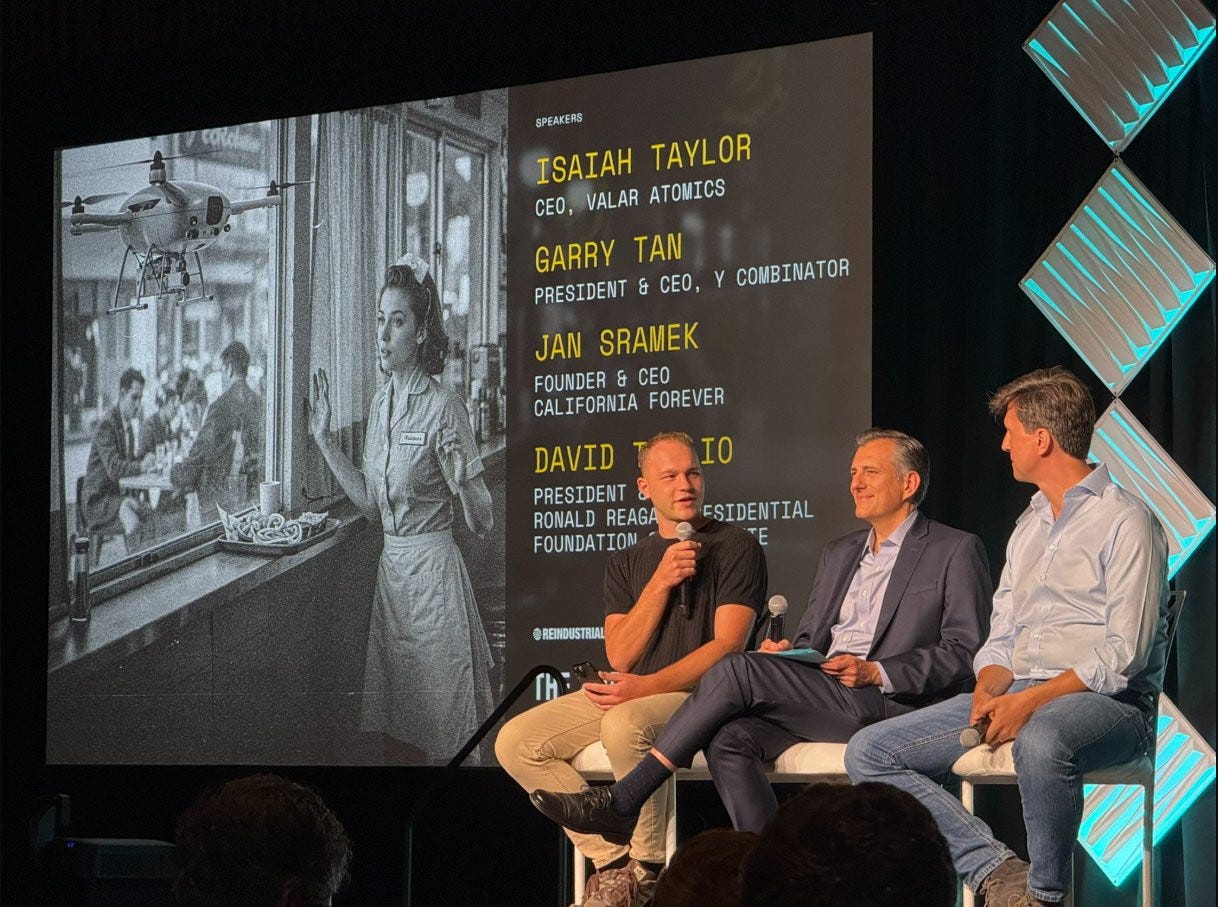

With these banner images, the summit has stumbled, perhaps accidentally, into a working aesthetic for modern American fascism. These images of Western expansion and 1950s Americana manifest the contradictory right-wing nostalgia for a fictive past: the elusive freedom of the famously deadly Oregon trail; the Western expansion for some that meant Western displacement for many others; the vigilante justice doled out by cowboys and by F-15s, which is not justice at all; the triumph of Fordism in the 50s, though not by or for women and black Americans; and the glory of total war, with its generations of shell-shocked veterans.
This is all a little stupid—and seems to contradict what the conference advocated for. The panelists and attendees no doubt waxed poetic about the promise of automation to have us working more productively, but the images they spoke under more accurately suggest superposition rather than replacement: We’ll have food delivery drones, but women will still be in diners; we’ll have sleek warfighter robots, but men will still be in the trenches, too.
What was the point of all the robots, then? Here, they’re revealing their hand: This is the future they want—a world where we’re in the trenches with the machines.
It’s worth mentioning that all these pictures are AI-generated. The nuclear cooling towers have no nuclear reactors next to them—and this image of baseball played under wind turbines has neither the batter standing on the plate nor the wind turbines placed intelligibly across the hill.

It’s all dripping with irony: Just as “artificial intelligence” interpolates from its training data to create something that appears sleek and transgressive but, really, represents a probabilistic mishmash of its inputs, conservatism mixes and matches compelling historical images to promise a cool-sounding but ultimately incoherent future.
I don’t think it’s some incredible “gotcha” to criticize this. These Reindustrialize summit conservatives clearly do not care if they make no sense because, if they really cared about rebuilding an American manufacturing base, they would have voted for Democrats. They would complain more about Trump gutting the state. But this is old news; we’ve known for some time that this stratum of society does not actually care about responsible management of the economy. They foam at the mouth for deregulation and also for war. If they do harbor more nuanced opinions about the administration, they’ll stay silent to make sure the White House doesn’t stop picking up their calls. And they will carry water for DOGE and for deportations so long as they can shuffle closer to power, while selling a story just transgressive enough to win some defense contracts and fail upward.
But a transgressive story of national rebirth through Trump’s promised manufacturing renaissance is also suspect. There’s something inherently wrong to these defense-tech venture capitalists about the idea of a country where manufacturing is not the bedrock of the economy. The Reindustrialize summit’s manifesto—yes, it has a manifesto—written by Aaron Slodov—stresses this point to an absurd degree: “The idea of a post-industrial economy is a dream cooked up by nihilists.”2 Aside from the fact that this is an odd invocation of nihilism—do nihilists dream aspirationally about the future of society?—I want to take this point seriously: Right now, we’re “addicted to services”; it’s bad that the healthcare sector is the largest employer in most states. Slodov thinks that society, writ large, only achieves true freedom and true purpose through achieving the ability to produce anything people need.3 Put another way, Slodov sees no point to a society unless it is somehow visibly “industrial.”
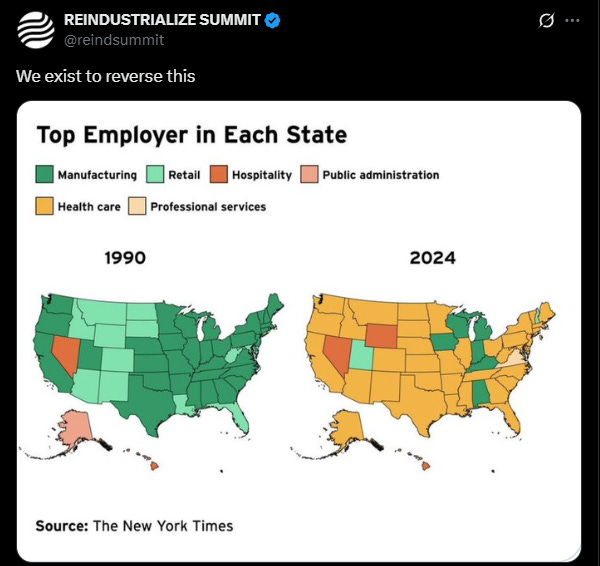
This vision is nationalistic, gendered, and, as a visionary project, disconnected from perhaps more normal concerns such as affordability, inequality, and the equitable distribution of education and healthcare. But are we surprised that a man who says that “we don’t get to Mars and become a multi-planetary species by building SaaS” thinks this way?4 Calling his opponents nihilists while flirting with the cold existentialism of robots—this is textbook reactionary futurism.
Reactionaries have long dreamed of building a fascist utopia in which a genetically gifted elite would be free to use their innate genius to develop advanced technologies. For many decades, neo-Nazis have argued that space colonization will be carried out by Aryan men driven by a white European spirit that yearns to explore and expand into new territories. Space is especially appealing to them because it represents a Lebensraum devoid of any Indigenous population that might mix with the white race.
…
Only a belief system as flamboyantly science-fictional as reactionary futurism can project a potential world extravagant enough to justify the techno-fascists’ disregard for actual human life.
Carroll is right to emphasize space travel as the next frontier for the reactionary futurist—quite a few events at the Reindustrialize summit discussed space as a site of exploration, extraction, and military dominance.
These “techno-industrialists,” these doormen for American fascism,6 are buzzing us into a dilapidated future. How the world they’re building received a permit, I don’t know. There are so many Americans who just don’t fit into their vision—who don’t want to die in pointless wars, who don’t want to get stuck in discriminatory service jobs, who don’t want to be policed out of the country in a fucked up reenactment of the true story of Western expansion, who need oxygen here on Earth rather than on Mars. The American conservative program is something the left already opposes politically―but we should oppose it aesthetically, too.
People complain about there being a lack of vision in center-left politics. But the vision on the other side of the aisle is so… empty. These “Reindustrialize” types can make their vision of the future look as transgressive as they want, but, really, their imagination is childishly regressive: The future, like the past, amounts to nothing more than work and war. It’s worse than bad—god, it’s boring.
I mean “bipartisan” in the very narrow sense that Sullivan is a high-profile Democrat. I don’t really think he represents Democrats—nor should we let him at any point.
Another real sentence: “It will be heavy industry that becomes indistinguishable from magic.” He’s not really saying anything that someone in the 1800s couldn’t have said. I often joke about how Silicon Valley techies approach the idea of manufacturing all wrong; this “manifesto” is a pretty successful demonstration of that entire phenomenon, to the point of self-parody.
Aaron Slodov, consistently fails to understand The Economy or demonstrate a coherent economic policy. From Joey Politano: “would help if the REINDUSTRIALIZE AMERICA ONE BILLION TARIFFS RESTORE THE HEARTLAND people could decide whether the tariffs are supposed to incentivize countries to invest in the US instead of exporting to the US, or if they hate when other countries invest in the US.”
“SaaS” is the abbreviation for “Software as a service,” a common Silicon Valley business model.
Carroll’s essay is mostly a review of a lot of good books investigating the modern right-wing psyche. It usefully pushes back against the Alex Karp-fueled argument that software engineering is a “memetic” and therefore useless career:
Techno-fascism serves as a novel way of disciplining workers, but I also think that we may be seeing the birth of a new spirit of capitalism. Tech companies have long extracted more labor out of their employees by offering creatively fulfilling work that they promised would help bring about a utopian vision to change the world. Tech workers were shaggy-haired artists and craftspeople in black turtlenecks—monomaniacal in devotion but also independent-minded and rebellious. This spirit simply will not work for building terror weapons, and so techno-fascism has begun to develop another ethos of self-sacrifice. The new tech employee will work punishing hours out of martial virtue in the service of maintaining national supremacy over and against China, a rival that, we are told, threatens the “future of the west.”
The doormats, too, once they get stepped on.
Jesus, Advait, you just ethered that summit. You captured what I couldn't put into words myself. Excellent post.
with the DHS tweeting out that manifest destiny painting, i'm really seeing the aesthetic coming together... great piece!