
Climate policy denial
The retconning of the Inflation Reduction Act. Plus: Plugging new (old) writing, and sharing some capsule reviews

In this post:
Plugging new (old) writing in Dissent!
Some notes on “climate policy denial” among Democrats
A plug for the Caravanserai magazine of policy and culture!
Reading/watching: the Green Knight, Where the Axe is Buried, and the Electric Valley
New (old) writing
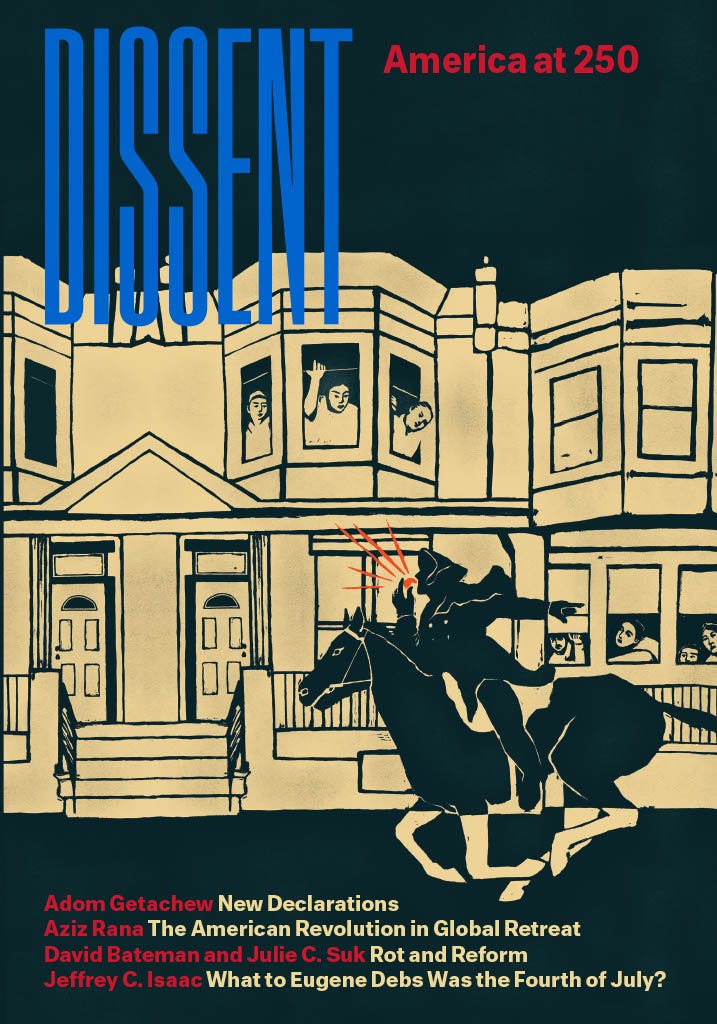
I’m very happy to say that my review of David I. Backer’s “As Public As Possible,” which I released in draft form here in December, was adapted and published for Dissent Magazine’s “America at 250” summer issue!
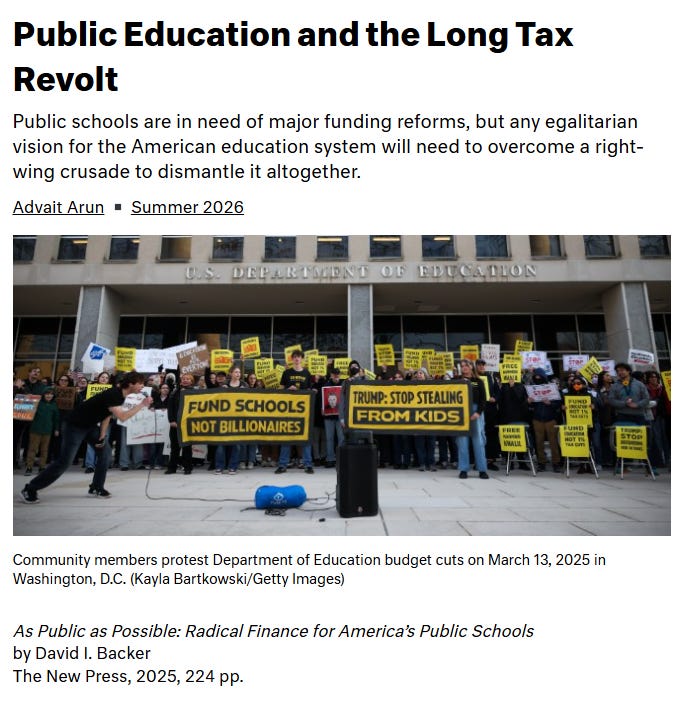
You can read it here for free! Thanks very much to the Dissent editors for their really great, incisive work. The rest of the Dissent pieces are really great, too.
The December draft of my review includes more thoughts about the book than could fit the magazine, but it’s also much less organized.


Climate policy denial
There’s a genre of pieces that I’ll label “climate policy denial” that seems to be taking up increasing oxygen among the left-of-center commentariat. Upon first glance, these pieces seem to make very similar sets of claims—chief among them that climate change is not Americans’ top priority.
Daniel Propp, in Foreign Policy, argues that,
whenever possible, the next administration should resist the urge to roll out splashy, top-down programs, instead allowing climate considerations to quietly permeate the regular operations of federal agencies. Decentralizing and diffusing climate action into the federal bureaucracy would make it more targeted and likely to last. It would acknowledge that though most Americans want the federal government to tackle climate change, fewer prioritize it over public safety, the cost of living, or the economy. Climate action embedded into agency policymaking would reframe it as complementary to other objectives, not a competing priority.
Matt Huber, in the New York Times, takes a similar view:1
Democrats will surely continue to propose policies calling for jobs and public investment, but it’s not clear why climate should be at the center. American voters broadly agree that climate change is a real concern and support addressing it, but they largely do not see it as a top priority.
But this likeness belies some contradictory animating assumptions. Propp thinks Biden’s climate policy was too visible, too central to the administration’s goals, and stretched over too many technocratic domains to be coherent—making it all the easier for Trump to rip it all to shreds against the wishes of a “climate-concerned” public. Better to give federal agencies flexibility to work under the radar.2
Meanwhile, Huber argues that Biden’s climate policies were not visible enough to move voters; concerns over inflation and affordability clearly motivate them more, and for Democrats to platform “climate” now risks being seen as out of touch. He recommends focusing on policies improving affordability for the working class which, incidentally, will also advance decarbonization.
For what it’s worth, I don’t think either set of recommendations is wrong. Huber’s right that the Democratic Party shouldn’t go out of its way to be out of touch, and Propp’s specific arguments that “climate policy” encompasses too much to be descriptive to the electorate are interesting and worth considering. But their agreement that voters must, obviously, care more about affordability than about something like climate only papers over extant contradictions about the kind of policymaking they want to see from Democrats. Was Biden’s climate policy too visible—and therefore too open to criticism for under-delivering—or not visible enough—and therefore unable to build a mass base of support? Does climate policy need to be technocratic and quiet or more all-encompassing and bombastically pro-worker in order to deliver? Propp and Huber—whom I’m singling out because I’ve read them most recently—would not be wrong to suggest that policymakers can find creative ways to do both, so long as climate isn’t at the center of a future administration’s messaging strategy.
Of course voters are more exercised right now about cost of living than other issues—but something strikes me as weird about how all this commentary assumes that the Democratic Party’s emphasis on climate policy is a live issue.
For one, neither Biden nor Harris talked much about climate or the Inflation Reduction Act during the 2024 campaign season. The landmark law was barely mentioned. And the Democrats winning the 2025 elections didn’t talk about climate either. So to argue that Democrats must avoid talking about it is, well—it already happened. We have “energy prices” and “affordability” now! But, second, pieces like Propp’s and Huber’s imply that the failure of the Inflation Reduction Act is what contributed to Trump’s win in 2024. This is a huge misunderstanding, not just because Biden and Harris never tried to campaign on it, but it’s implausible to view Trump’s victory as a form of climate policy backlash. Broad climate messaging—or the lack thereof—had little to do with Biden’s unpopularity, Democrats’ lack of a compelling platform otherwise, and their subsequent losses. For all the IRA’s shortcomings and its lack of political visibility, both of which I readily concede, Democrats’ feelings about climate had nothing to do with Trump’s victory or his desire to tear up Democratic legislation—which Republicans would have done anyway.
Kate Aronoff has a good piece out in the New Republic that takes aim at some of these arguments.
The so-called “climate hushers” are right about some things: The particular way that party candidates and lawmakers have talked about climate over the last several years clearly hasn’t furnished them with electoral majorities. It doesn’t seem to be a huge factor in the party having lost them, either. Democrats won in an election year where “climate” was a big talking point for candidates, including Biden; they lost an election where they barely mentioned it.
She agrees that slogans such as “fight climate change!” are not “especially helpful for building the durable, hegemonic majorities necessary to accomplish those goals.” Democrats will have to look elsewhere for an electoral plan that leads them to victory—perhaps toward the style of Mayor Mamdani.
Populist policies to mitigate and adapt to the climate crisis are thankfully pretty popular. They’re also too big—and too threatening to elites—to be quietly enacted by politicians claiming their only concerns are affordability and lower energy prices. Keeping people safe in a climate-changed world means fighting with Republicans and the monied interests that pay the GOP to defend their interests: a blank check to extract fossil fuels and accumulate wealth indefinitely. Denying the realities of a warming planet by keeping certain words out of your mouth won’t make the powers that be look the other way.
She’s right. The only way to win an electoral coalition and a large-scale public spending program is to advance a charismatic politics that doesn’t shy away from identifying concrete ways to make peoples’ lives more secure—even if it gets CEOs complaining. As FDR himself once said, “I welcome their hatred.” But that never meant pretending problems like climate change all of a sudden don’t matter. So I worry that pieces in the “climate policy denial” genre are retconning the relationship between climate policy and Trump’s victory. These arguments spur a vicious cycle where this kind of argument about how the Inflation Reduction Act and the Green New Deal that germinated it were Democrats’ undoing—which is not true!—ends up being intellectual scaffolding for moderates who would happily reject ambitious spending on a visionary slogan.
The irony here is that the authors of these “climate policy denial” pieces very clearly love the idea of big public spending programs for energy and infrastructure. Their political incrementalism, however, takes the electoral landscape for granted and thereby dooms their own ambitions. First: Democrats cannot Trump-proof climate policy by submerging it such that Republicans don’t notice. How effective could a hidden climate policy even be, to say nothing of how much lending or spending it could unlock, if Republicans are hell-bent on destroying the federal government it’s hidden in? Second: What message do Democrats even submerge it in to get what they want? How confident are we that “affordability” is a large enough umbrella under which to stuff public investment programs advancing rapid, wholesale, economy-wide decarbonization. These are open questions that the climate policy denial scene neglects to answer. But I’m not optimistic about either one. Democrats have to win to get what they want. Winning requires reshaping the electoral landscape. I won’t claim I know what that requires, but I have to imagine it means suggesting something bolder than telling other Democrats not to say something they’re not even saying.
A plug for Caravanserai
Caravanserai Volume 2 is a bit over halfway done. We’ve been publishing some really incisive issues on climate adaptation in the Global South, the role of LLMs in the humanities, the future of the federal bureaucracy, strange political bedfellows, and the nature of the Trump Administration’s unbridled imperialism.
If you aren’t already following Caravanserai, I’ll bring you up to speed: It’s a magazine of policy and culture that I co-edit alongside my friends Aastha and Daevan. Every issue is comprised of a prompt that three writers answer in about 500 words each, a structure which empowers our writers to be provocative rather than get too in the weeds. And, importantly, our writers are all anonymous. They’re all working on the topics they’re writing about. It’s very fun to read.
Join the camels and let us know what you think. We’re always taking letters to the editor, too. Read more here:

Cool things I’ve read/watched lately:
Every time I watch the Green Knight (2021) I realize I love it more than I did the last time. Of course the cinematography is gorgeous, and of course Dev Patel’s performance is stunningly good—on those two counts alone the movie is a masterpiece. But I gravitate to how uncomfortable the movie makes me: Every decision Gawain makes, until the denouement, seems to stray from the code of chivalry. “Is that what a knight would do?” is not a question Gawain seems to ask himself all that often, but it’s what we have to ask ourselves as he plods through the medieval English countryside, making questionable choices of all kinds. But, at the end of his search for renown, he finds his integrity.
Where the Axe is Buried (2025), by Ray Nayler, is science fiction set in the near future about a distributed network of rebels trying to dismantle governments across Eurasia run by artificial intelligences and, in Russia, run by a president who perpetually reuploads his consciousness into new bodies. The regimes at hand are high-tech police states with access to citizens’ biometric and consumption/preference data. The rebels’ networks must therefore be so distributed that very few of them are even allowed to understand the role they are playing. Into this milieu arrives Lilia, a Russian computer scientist working in England who designs a device that subtly but directly shapes and manipulates peoples’ decisions—which the rebels want to use to topple the eternal Russian president in particular. This book is undeniably a page-turner, and it’s full of beautiful imagery comparing cybernetic human institutions to natural ones like fungal root networks and honeycombs. But I think its desire to stress how our technological and cultural systems separate our agency from our decisions, such that nobody’s decisions are intrinsic—such that the present must be built along the grooves and striations of the past—ends up feeling overdone, even nihilistic.3 The book’s optimism about social change, to me, feels undercut by its refusal to let any of its protagonists demonstrate any kind of existential freedom. And I think that’s Nayler’s point… but I didn’t love it.
The Electric Valley (1984) is an old documentary about the Tennessee Valley Authority featuring tons of archival photography and footage, as well as interviews with leading lights such as TVA leader David Lilienthal himself and Senator Albert Gore, Sr. I got a bunch of my friends to watch it with me—and I really loved it. The archival footage of plant construction, more contemporary footage of nuclear plant construction, and the flyovers of environmental devastation were all really striking. We cheered when FDR pressed a button and the Norris Dam started flowing. We cheered even louder when they showed the footage of Lilienthal buying up Wendell Willkie’s private utility holdings. And I had no idea about the near-miss of a meltdown at the Browns Ferry nuclear plant. The documentary does a fair job of trying to present how TVA leaders were handling (definitely unsuccessfully) growing community opposition as the institution morphed into a utility only really interested in building more rather than reclaiming its old economic development functions. (Although you could argue that its debt limit and its “fenceline” around its service area may have pushed it in this direction. Not an excuse moreso than a warning for public power.) And the interviews of families being pushed off their land for dams that ended up having no industrial function and of households downwind of coal plants really testify to the importance of preserving a social contract around economic development—which TVA did not.
Yes, the Matt Huber who wrote Climate Change as Class War.
I have a substantive disagreement with Propp here. I think it’s wrong to argue that Republican chainsaws won’t come for the kind of quieter, more technocratic climate policy that might be implemented by federal agencies without an executive order, as he recommends. The chainsaws are already here! Trump’s government is gutting bipartisan programs of all kinds, whether or not they were authorized in law, directed by executive order, or simply permitted via federal agency competencies. It misreads Republicans to think that Democratic party administrators can successfully submerge climate policy within broader government functions when Republicans are trying to destroy those government functions writ large.
At Crow’s Nest, Ltd., we’re big believers in preference obscurity. I love nonfiction analyses of this topic—and it’s clear Nayler has read a lot of the same stuff, too. His conceptualization of what near-future, dystopian “data-driven” governance could look like—where you look at advertisements and the advertisements look back—feels plausible. But I find that applying these concepts to fiction without some kind of subjective “transcendence,” if you will, leaves me feeling unsatisfied.